

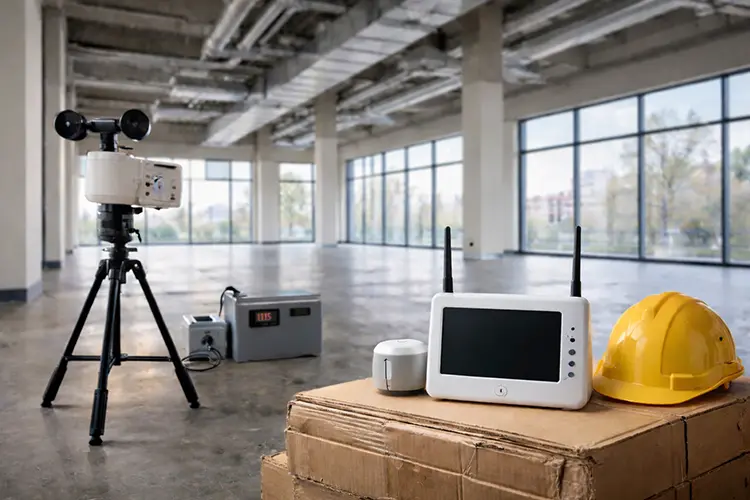
When most people think about vacant property security, they picture cameras, fences, or guards. Yet some of the most expensive losses in empty buildings come from environmental issues like leaks, freezing pipes, mould, smoke, and utility failures that go unnoticed for weeks.
Environmental and utility monitoring closes this gap. It turns vacant buildings from silent liabilities into actively managed assets, spotting problems early and protecting both insurance cover and property value.
You’ll find how environmental monitoring works, what insurers expect, and why it’s now a critical part of modern vacant property security.
Vacant buildings behave differently from occupied ones:
The result is slow-developing damage that spreads unchecked. In many cases, the initial fault is minor. The delay is what turns it into a five-figure loss.
Related article: Environmental damage in empty buildings
Escape of water is one of the most common and costly claims in vacant buildings.
Why leaks hit harder in empty properties:
Even a slow drip can lead to:
Insurance reality: many insurers reduce or reject claims if leaks weren’t detected promptly or inspections weren’t logged.
Vacant buildings often lack:
This creates ideal conditions for mould, which:
Mould remediation is expensive and may not be fully covered if it’s classed as gradual deterioration.
Traditional fire alarms may:
Modern environmental systems include:
Early detection helps prevent:
Related article: Remote monitoring workflows in vacant properties
Utility failures trigger a cascade of risks:
Modern monitoring tracks:
Timely alerts let owners intervene before secondary damage kicks in.
Environmental monitoring uses networked sensors across a vacant building to track conditions in real time.
Common sensor types
| Sensor | Detects | Prevents |
| Water leak | Pipe bursts, ingress | Flood damage |
| Temperature | Freezing conditions | Burst pipes |
| Humidity | Damp and mould risk | Structural decay |
| Smoke/heat | Fire | Major loss |
| Power | Utility failure | System shutdown |
These sensors send alerts to a 24/7 monitoring centre, not just a phone app.
There’s a critical difference between standalone alarms and monitored systems.
Monitored systems provide:
This documentation is often the difference between a paid claim and a rejected one.
Related article: Insurance polices for vacant buildings
Insurers increasingly:
They typically expect:
Environmental monitoring demonstrates reasonable risk mitigation, which sits at the heart of claim approval.
Residential voids
Prevent frozen pipe claims. Protect short-term vacancies. Maintain insurability.
Commercial buildings
Large pipework systems. Plant rooms and HVAC. Higher repair costs.
Redevelopment sites
Long periods without occupation. Utilities partially active. Complex building systems.
Public sector and heritage buildings
Sensitive materials. High reinstatement costs. Strict duty of care.
Related articles: Vacant property security for landlords, Securing empty commercial units, Redevelopment site security, Council vacant building security
Environmental monitoring alone won’t stop intruders, and intruders can cause environmental damage. Best practice combines:
This delivers continuous protection, not just reaction.
Typical monitoring costs are far lower than one claim excess.
Illustrative scenario
| Scenario | Estimated cost |
| Burst pipe repair, early detection | £500–£1,500 |
| Undetected water damage | £20,000–£50,000+ |
| Monitoring, monthly | £50–£250 |
One prevented incident can pay for years of monitoring.
Environmental damage doesn’t break doors or trigger intruder alarms. It works quietly until it’s too late. Environmental monitoring gives vacant buildings a voice. It alerts you when something goes wrong, proves action was taken, and protects both value and insurance.
We provide fully monitored solutions including:
Request a monitoring assessment today, contact us

Head Office
18-20 Millbrook Road East,
Southampton, Hampshire, SO15 1HY
Tel: 0800 799 9800
Email: info@veritech-security.com
Hours: Monday - Sunday: Open 24 Hours

Simply complete our quick survey below
