

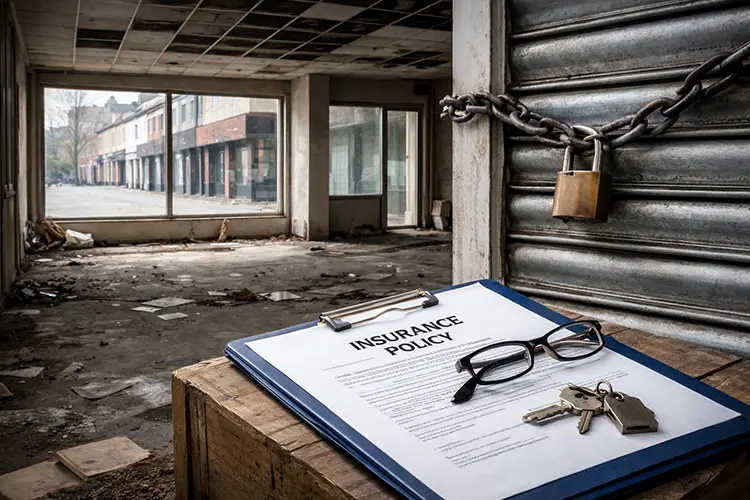
When a property sits empty, many owners assume their standard insurance still applies. In practice, most policies restrict cover once a building is classed as “unoccupied” or “void,” and claims can be rejected if you miss specific conditions.
This guide breaks down how insurers define vacancy, the clauses owners often overlook, and the security measures you’ll need to keep cover intact.
Policies vary in wording, but they tend to agree on one point:
A property becomes “unoccupied” when nobody is living or working in it, even if it’s furnished or actively for sale or lease.
Typical void triggers
| Scenario | Is it ‘vacant’? |
| Between tenants | ✔ Yes |
| Closed business awaiting re-let or sale | ✔ Yes |
| Redevelopment waiting for planning approval | ✔ Yes |
| Holiday let with no bookings for 30+ days | ✔ Often |
| Property empty during probate | ✔ Yes |
| Owner away for travel but intends to return | ✔ No |
Time limits to watch
Most insurers apply restrictions after 30 days. Some commercial policies allow 60 to 90 days.
Your policy usually stays in force, but cover reduces automatically, especially for higher-risk events:
Most insurers require you to notify them when a property becomes vacant. If you fail to report it, a claim can be denied even if your security looks adequate.
Vacant property cover nearly always comes with conditions, often called “unoccupancy clauses” or “warranties.” These are the big ones.
Most policies require documented inspections at set intervals.
| Property type | Inspection frequency |
| Residential | Every 7 to 14 days |
| Commercial | Every 7 days |
| High-risk areas, theft or arson | Daily patrols or monitored CCTV |
Inspection logs should include timestamped photos, utility checks, evidence of waste removal, and notes on damage or attempted entry.
If it’s not recorded, it didn’t happen.
Standard locks or simple timber boarding rarely meet requirements. Insurers often expect:
Some policies specify LPS 1175-rated products for commercial or public buildings.
Related article: Steel Screens & Boarding Explained
Policies increasingly distinguish between passive recording and live monitoring by an accredited centre.
Live monitoring enables verified police response, instant audio warnings, and clear evidence logs.
Insurers may insist on real-time monitoring if the site is in a high-crime area, holds valuable plant or equipment, has previous claims, or sits on open land or in a remote location.
Related articles: CCTV towers vs Traditional Guarding, Remote security monitoring explained
You may need either controlled heating to prevent frozen pipes or full isolation of water supplies with documented proof. Some insurers won’t pay for burst pipes if the heating was off without approved measures in place.
Empty sites attract rubbish and fly-tipping, which increase fire and liability risks. Policies often set deadlines such as: “Remove combustible waste within 7 days.” Miss it and related fire claims can be declined.
After a major incident such as arson, squatting, burglary, or escape of water, your insurer may require upgrades to continue cover. Common requirements include:
These costs often exceed policy excesses. Prevention is cheaper.
Vacant properties produce large losses due to delayed detection, criminal damage that outweighs theft values, environmental damage that spreads, and liability during illegal occupation.
Example
A £500 leak can turn into a £50,000 mould, rot, and redecoration claim if it goes unnoticed for weeks.
Fire risks rise when fly-tipped waste ignites, vandals use accelerants, or squatters cause accidental fires. Claims for mid-sized buildings can exceed £250,000.
During a claim, expect requests for:
If any condition isn’t met, the insurer may argue that you failed to mitigate risk and reduce or refuse the payout.
| Requirement | Residential | Commercial |
| Notify insurer of vacancy | ✔ Usually | ✔ Always |
| Inspection logs | ✔ Every 7 to 14 days | ✔ Often weekly |
| Steel screens | Often recommended | Often required |
| Monitored CCTV | Optional | Frequently required |
| Alarm systems | Optional | Strongly recommended |
| Utilities management | Heating or isolation | Isolation preferred |
| Waste removal | Standard | Strict, higher fire risk |
Commercial policies carry tighter conditions because potential losses are greater.
Local authorities, NHS estates, and listed properties often face extra obligations due to public access, conservation rules, reputation, and duty of care. These sites are commonly required to use steel screens, monitored CCTV, and specialist contractors.
Related article: How councils vacant building security
Insurance is a conditional agreement. If you don’t meet the conditions, you won’t receive the protection.
Get ahead of the requirements to maintain cover, reduce premiums, avoid five-figure repairs, and cut legal risk during trespass. Security is part of compliance, not an optional extra.
We provide insurance-compliant protection for every building type:
Request a compliant security plan, contact us

Head Office
18-20 Millbrook Road East,
Southampton, Hampshire, SO15 1HY
Tel: 0800 799 9800
Email: info@veritech-security.com
Hours: Monday - Sunday: Open 24 Hours

Simply complete our quick survey below
