

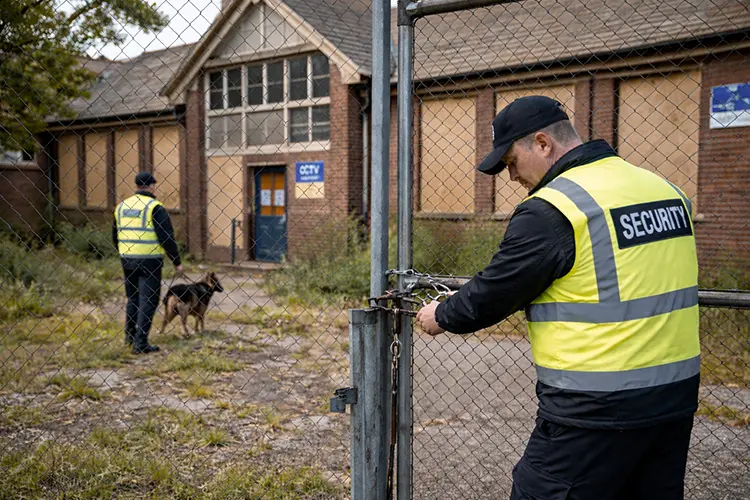
Across the UK, councils and public bodies manage thousands of vacant buildings, from closed schools and libraries to former care homes, depots, leisure centres, and community halls.
These properties are not just empty assets. They are high-profile, publicly scrutinised sites. Security failures can trigger reputational damage, legal liability, and financial loss that go far beyond repair costs.
This guide explains how public sector organisations secure vacant buildings responsibly, meet compliance obligations, and protect public trust.
Unlike private property, public buildings are:
When a council building is left unsecured, consequences may include:
In public sector estates, security failures quickly become public issues.
Public bodies are responsible for a wide range of vacant assets, including:
Each carries different risks, but all require documented, defensible security measures.
Empty public buildings often attract:
Arson in vacant public buildings is especially serious due to:
Squatting in residential buildings is a criminal offence. Many public sector buildings fall under commercial property rules, so eviction is a civil matter.
This can result in:
Related article: Squatter prevention in vacant properties
Public bodies retain a duty of care even when a building is vacant.
If an unauthorised person is injured:
Public sector insurance arrangements typically require:
Failure to comply may result in:
Related article: Vacant property – Environmental monitoring
Public sector estate teams must balance:
Security decisions must be:
✔ Justifiable
✔ Proportionate
✔ Documented
✔ Auditable
Standardised, repeatable security frameworks make this achievable.
Preferred for:
They:
Prevent reputational damage from repeated boarding failures
Live-monitored CCTV provides:
Particularly effective for:
Related articles: Inside a 24/7 Remote Monitoring Control Room, CCTV Towers vs Guards
Inspections must be:
Mobile patrols often provide:
Vacant public buildings often contain:
Monitoring helps prevent:
Heritage assets require:
Steel screens and monitoring systems should be specified sensitively to protect character and fabric.
Vacant public buildings can become focal points for:
Visible security demonstrates responsible stewardship, risk awareness, and commitment to public safety. Clear signage and maintained exteriors reduce the perception of neglect.
Public sector budgets are under pressure, but under-securing buildings leads to:
| Cost | Typical Range |
| CCTV tower | £800–£2,000 per month |
| Steel screens | £500–£2,000 |
| Patrols | £300–£1,200 per month |
| Major arson repair | £50,000–£500,000+ |
📌 Preventative security is both more economical and more defensible.
Final Thought: Public Assets Deserve Public Protection
Public sector buildings represent community investment, public trust, and social value. Securing vacant public buildings is not just a technical task, it is a governance responsibility.
Councils that plan security proactively:
We work with councils and public bodies to provide:
✔ Insurance-compliant security frameworks
✔ Steel security screens and doors
✔ CCTV towers and live monitoring
✔ Inspection and patrol services
✔ Full audit and reporting support
Arrange a public sector security consultation, contact us

Head Office
18-20 Millbrook Road East,
Southampton, Hampshire, SO15 1HY
Tel: 0800 799 9800
Email: info@veritech-security.com
Hours: Monday - Sunday: Open 24 Hours

© 2026 Veritech Security is a trading name of Veritech Systems Limited | Company Registration No. 07095234 | Social Responsibility Policy | Sitemap | Privacy Policy | Policies and Procedures | Veritech Systems Limited holds SIA approved contractor status for Security Guarding, CCTV and Keyholding security services.
Simply complete our quick survey below
