

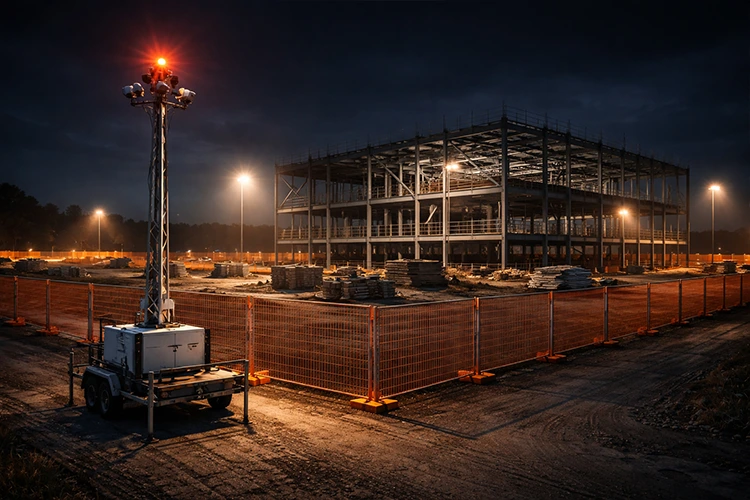
Construction sites are among the most frequently targeted locations for theft and criminal damage in the UK. With valuable plant, materials, tools, and equipment often left on site overnight, and perimeters that change shape as a project develops, securing a construction site presents a specific set of challenges that standard commercial security approaches don’t always address well.
Perimeter security systems are the first and most important line of defence — but the right combination of solutions depends on your site, your project timeline, and the specific risks involved. If you’re a site manager, project manager, or contractor responsible for site security, the question isn’t usually whether you need perimeter security — it’s which approach is right for you.
This article breaks down the three main options — perimeter intrusion detection systems (PIDS), manned guarding, and mobile CCTV towers — and helps you understand when each one is appropriate and how they work together.
Construction site theft costs the UK industry an estimated £800 million annually, according to figures from insurer Allianz Cornhill that are widely cited across the sector. Plant theft, cable theft, tool theft, and material theft all contribute — but the less-reported cost is the disruption. Replacing stolen equipment takes time. Insurance claims cause delays. Re-mobilising after a significant theft can set a project back by days or weeks, with knock-on implications for programme, costs, and client relationships.
Most incidents happen at night or over weekends when sites are unmanned. An unprotected perimeter is an open invitation.
Perimeter intrusion detection systems use sensors positioned along the site boundary to detect any unauthorised breach and trigger an immediate alert. On a construction site, this typically involves infrared beams, microwave detectors, or wireless sensor units that form a virtual boundary around the perimeter.
When PIDS works well on construction sites:
The key strength of PIDS is early detection. The system registers an intrusion at the boundary — before any theft or damage has occurred — and alerts a monitoring centre or on-site guard immediately. That early warning is what creates the opportunity for an effective response.
Modern wireless PIDS systems are battery-powered and don’t require mains connection, which suits construction sites well. Units can cover up to 2,000 metres of perimeter with multiple sensors, and the system can be extended as site boundaries change.
A physical security presence — SIA-licensed guards on site overnight or at weekends — remains one of the most visible and effective deterrents available. The presence of a guard is immediately apparent to anyone approaching the site, and a trained officer can assess, respond, and communicate in ways that a sensor or camera cannot.
When manned guarding is the right choice:
Manned guarding is typically more expensive than technology-based solutions, which is why it’s often deployed in combination rather than as a standalone measure. A single guard is also limited in the area they can monitor at any one time — which is why pairing guarding with CCTV or detection technology significantly increases overall effectiveness.
Mobile CCTV towers are self-contained, rapidly deployable security units that combine camera surveillance with monitoring and — on advanced units — integrated lighting, audio challenge capability, and alarm activation. They run on solar or battery power and can be positioned and repositioned across a site without any fixed installation.
When mobile CCTV towers work well on construction sites:
CCTV towers connected to a 24/7 monitoring centre provide verified response capability: when movement is detected, an operator views live footage, assesses whether a genuine intrusion is occurring, and triggers the appropriate response. This reduces false alarm callouts significantly compared to basic motion-triggered alarms.
In practice, the most effective construction site security strategies combine two or more of these approaches. A common and cost-effective configuration for a mid-to-large construction project would be:
For smaller sites or shorter-duration projects, a single well-positioned CCTV tower with monitoring may provide adequate coverage at a proportionate cost.
The right combination depends on your site’s size, location, project phase, the value of assets on site, and your existing security obligations under your contract or insurance policy.
Veritech Security works with principal contractors, project managers, and construction businesses across the UK to design, install, and manage perimeter security systems that protect sites throughout the full project lifecycle.
Our services relevant to construction site perimeter security include wireless PIDS providing full-boundary early breach detection; mobile CCTV towers for monitored visual coverage of compounds and high-risk zones; SIA-licensed manned guarding and dog handler patrols; NSI Gold-accredited 24/7 remote monitoring with verified response protocols; scaffold alarms and access control for compound and plant protection; and construction site CCTV installation with full operational documentation to support insurance compliance.
We hold SIA approved contractor status alongside ISO 9001, ISO 14001, Constructionline, SafeContractor, RISQS, Achilles, and Cyber Essentials accreditations — the credentials that principal contractors and their insurers expect to see.
If you have a construction project that needs a security solution, speak to Veritech before the plant goes on site.
Call: 0800 799 9800 (available 24/7) Email: info@veritech-security.com Or request a site security consultation online.

Head Office
18-20 Millbrook Road East,
Southampton, Hampshire, SO15 1HY
Tel: 0800 799 9800
Email: info@veritech-security.com
Hours: Monday - Sunday: Open 24 Hours

© 2026 Veritech Security is a trading name of Veritech Systems Limited | Company Registration No. 07095234 | Social Responsibility Policy | Sitemap | Privacy Policy | Policies and Procedures | Veritech Systems Limited holds SIA approved contractor status for Security Guarding, CCTV and Keyholding security services.
Simply complete our quick survey below
