

If you’ve started researching perimeter security systems, you’ll quickly encounter the recommendation to arrange a site survey before specifying any equipment. It’s advice worth taking seriously — but what does a perimeter security survey actually involve, what should you expect from the process, and why does it matter for getting the right system?
Perimeter security systems can only perform as well as the survey and specification behind them. This article walks through what a professional perimeter security survey covers, what information it produces, and how it translates into a security specification that genuinely fits your site.
Perimeter security is not a product you can specify accurately from a brochure or website. Every site is different — in size, shape, terrain, existing infrastructure, threat profile, and operational context. A system that provides excellent protection on a flat, well-lit industrial estate may be entirely inadequate on a remote, open-terrain site; a solution appropriate for a construction compound may be disproportionate for a commercial car park.
Specifying without a survey typically means one of two outcomes: over-specification (paying for capability you don’t need) or under-specification (deploying a system that leaves meaningful gaps in coverage). Either outcome is avoidable with a proper site assessment.
A survey also protects the client commercially. A security provider who installs a system without surveying the site in advance cannot give you reliable assurance that the system will perform as intended — and if it doesn’t, establishing responsibility becomes complicated.
A professional perimeter security survey covers several distinct areas.
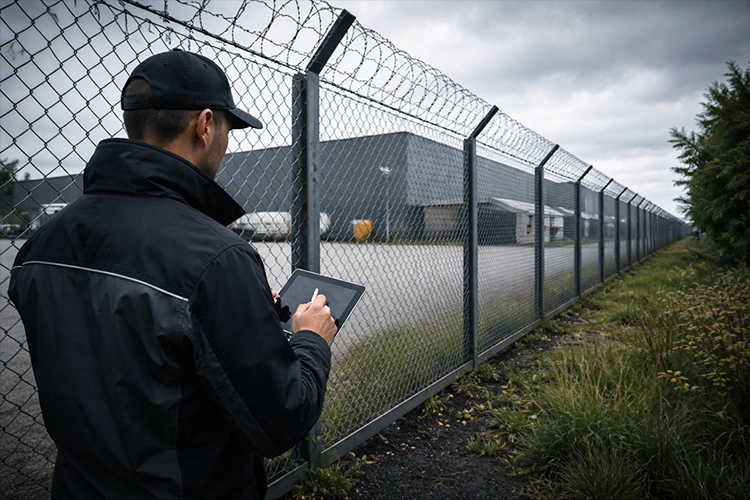
The surveyor walks the full perimeter of the site, mapping boundary lines, identifying access points (gates, vehicle entrances, pedestrian entrances), and noting the physical characteristics of the boundary itself — fencing type and condition, walls, natural boundaries such as hedgerows or waterways, and any areas where the boundary is unclear or disputed.
This baseline map forms the foundation of the sensor and camera placement plan.
Understanding what you’re protecting against is as important as understanding what you’re protecting. The surveyor assesses:
This risk assessment shapes both the specification and the prioritisation of coverage — ensuring the most vulnerable areas receive the most robust protection.
Physical environment significantly affects which sensor technologies are appropriate and how they should be configured. The surveyor assesses:
The availability of mains power at sensor positions determines whether wired or wireless systems are viable. The surveyor assesses:
Where mains power or reliable communications aren’t available across the full site, the surveyor identifies solutions — battery and solar-powered wireless sensors, radio mesh networks — that address the constraint.
Few sites start from scratch. The surveyor reviews any existing security infrastructure — CCTV, access control, intruder alarm systems, manned guarding arrangements — and considers how a new perimeter security system integrates with what’s already in place. Unnecessary duplication adds cost; logical integration adds value.
Some physical security measures — particularly fencing above certain heights, or structures adjacent to highways or in designated areas — require planning permission. The surveyor flags any likely compliance requirements, ensuring the proposed solution doesn’t inadvertently create a planning liability.
For sites with specific regulatory requirements — utilities, critical national infrastructure, certain healthcare or education environments — the surveyor also considers how the security specification aligns with applicable standards.
Following a thorough site survey, a professional security provider should produce a written report that includes:
This document should give you enough information to understand exactly what is being proposed and why — not just a quote for equipment. If a survey produces nothing more than a price list, that should prompt questions about the thoroughness of the assessment.
For a typical commercial or industrial site, a perimeter security survey takes between one and three hours. Larger sites — significant acreage, complex layouts, multiple zones with different risk profiles — will take longer. Remote sites may require additional assessment for communications infrastructure.
Veritech Security carries out professional site security surveys for commercial, industrial, construction, and specialist clients across the UK. Our surveys are conducted by experienced security professionals who combine technical knowledge of detection and monitoring systems with practical understanding of how sites operate and the real-world threats they face.
Every survey we conduct covers perimeter mapping, threat and risk assessment, environmental analysis, power and communications infrastructure, and integration with existing security arrangements. Our written survey outputs give clients a clear, justified specification — not a list of equipment with prices attached.
Our services following survey include PIDS installation and commissioning; wireless and wired perimeter alarm systems; integrated CCTV and monitoring; mobile CCTV tower deployment; NSI Gold-accredited 24/7 monitoring; and ongoing maintenance programmes. We hold SIA approved contractor status alongside ISO 9001, ISO 14001, Constructionline, SafeContractor, RISQS, Achilles, and Cyber Essentials accreditations.
If you’re ready to understand what your site actually needs, speak to Veritech to arrange a survey.
Call: 0800 799 9800 (available 24/7) Email: info@veritech-security.com Or request a perimeter security survey online.

Head Office
18-20 Millbrook Road East,
Southampton, Hampshire, SO15 1HY
Tel: 0800 799 9800
Email: info@veritech-security.com
Hours: Monday - Sunday: Open 24 Hours

© 2026 Veritech Security is a trading name of Veritech Systems Limited | Company Registration No. 07095234 | Social Responsibility Policy | Sitemap | Privacy Policy | Policies and Procedures | Veritech Systems Limited holds SIA approved contractor status for Security Guarding, CCTV and Keyholding security services.
Simply complete our quick survey below
