

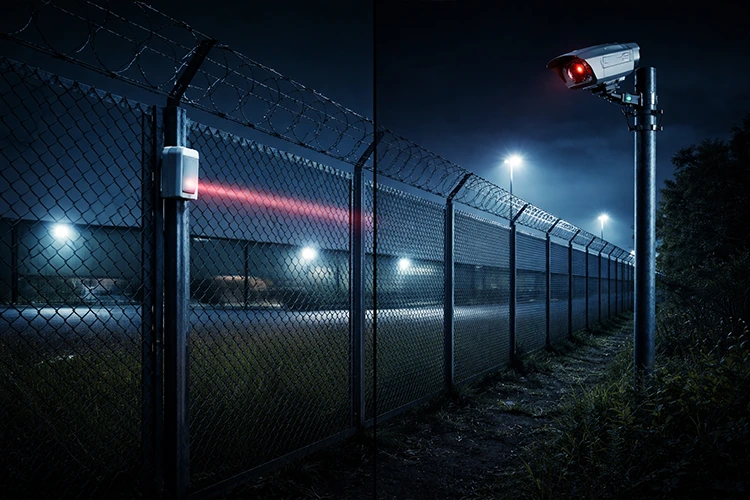
When organisations begin planning perimeter security, CCTV cameras are often the first solution that comes to mind. They’re familiar, visible, and well understood. But for serious perimeter protection — particularly on large sites, remote locations, or anywhere with a significant intrusion risk — relying on CCTV alone leaves meaningful gaps in your security.
Perimeter security systems that perform at the highest level combine Perimeter Intrusion Detection Systems (PIDS) with CCTV in an integrated solution. Understanding the difference between the two, and how they work together, is fundamental to specifying a system that actually performs.
CCTV cameras are primarily a recording and monitoring technology. Fixed cameras positioned around a perimeter provide visual surveillance of specific zones, allowing security personnel or monitoring centre operators to observe activity and review footage after an incident. Modern CCTV systems — particularly those with video analytics capabilities — can also detect motion and trigger alerts when movement is registered within a camera’s field of view.
CCTV is valuable for several reasons:
The fundamental limitation of CCTV for perimeter protection is coverage. A camera has a defined field of view — perhaps 50 to 100 metres at useful resolution under good conditions. Protecting the full perimeter of a large site using CCTV alone requires a very large number of cameras, careful positioning to eliminate blind spots, and reliable lighting conditions for effective night operation. On a site with a perimeter of several hundred metres or more, the cost and complexity of achieving true full-perimeter CCTV coverage is significant.
There’s also the question of detection vs recording. Standard CCTV captures what happens, but doesn’t reliably trigger an alert at the moment an intrusion occurs — particularly if no one is actively monitoring the feed. Video analytics improves this, but camera-based motion detection generates a high rate of false alerts due to environmental factors such as lighting changes, vegetation movement, and wildlife.
Perimeter Intrusion Detection Systems are designed specifically to detect the act of crossing or breaching a physical boundary. Rather than relying on visual monitoring, PIDS use sensor technologies — infrared beams, microwave detectors, fibre-optic cables, radar — to create a detection zone along the perimeter line itself.
When that zone is breached, the system triggers an immediate alert. The detection is not dependent on lighting conditions, camera angles, or someone actively watching a screen. It happens at the boundary, at the moment of intrusion.
PIDS characteristics that distinguish them from CCTV:
Perimeter-specific. PIDS are engineered to detect intrusion at a boundary line, not to monitor a general area. This specificity makes them highly effective at the task they’re designed for.
Full-perimeter coverage. Sensor arrays can cover the entire boundary of a large site — including areas where CCTV coverage would require impractically large numbers of cameras. A single PIDS deployment can protect perimeters measured in hundreds or thousands of metres.
Environmental performance. Modern PIDS are designed to operate reliably in darkness, rain, fog, and temperature extremes. Infrared sensors detect heat, not light. Microwave and radar sensors detect movement through environmental conditions that would compromise camera image quality.
Lower false alarm rates. Well-designed PIDS with appropriate sensor calibration produce significantly fewer false alarms than camera-based motion detection, because sensor technology can be tuned to filter out environmental movement whilst reliably detecting human intrusion signatures.
Detection before damage. PIDS detects an intrusion at the perimeter — before an intruder has reached buildings, equipment, or assets. CCTV typically records what is happening once someone is already on site.
PIDS are not a complete security solution in isolation. The primary limitation is that a PIDS alert tells you that an intrusion has occurred, and roughly where — but it doesn’t tell you what is happening. Without visual confirmation, a monitoring centre cannot verify whether the alert represents a genuine threat or an environmental trigger, cannot assess the nature of the intrusion, and cannot provide accurate information to a responding officer.
This is why PIDS is most effective when integrated with CCTV.
The combination of PIDS and CCTV addresses the limitations of both:
This integrated approach means that a monitoring centre operator doesn’t have to watch dozens of camera feeds simultaneously hoping to notice something. The PIDS alert directs attention to the right camera at the right time. Response is faster, more accurate, and more likely to result in intervention before damage or theft occurs.
On a large site, this combination is also more cost-effective than trying to achieve comprehensive CCTV coverage alone — fewer cameras are needed, because PIDS handles the detection layer and CCTV provides targeted verification.
A simple framework for thinking about this:
CCTV alone may be adequate for small sites, premises with good external lighting, locations where visual monitoring and recording is the primary objective, and environments where the perimeter is already physically secure and the risk is primarily internal.
PIDS alone provides strong boundary detection but should always be paired with a monitoring and response capability. Without verification, every PIDS alert requires physical investigation, increasing costs and the risk of complacency if environmental activations are frequent.
PIDS integrated with CCTV is the appropriate specification for large sites, high-risk assets, remote locations, sites where early detection is critical, and any situation where the cost of a successful intrusion — in theft, damage, or operational disruption — justifies a serious investment in prevention.
Veritech Security works with commercial, industrial, and specialist clients across the UK to design perimeter security solutions that combine PIDS and CCTV in genuinely integrated systems — with 24/7 monitoring and response built in from the outset.
Our integrated perimeter security services include PIDS deployment across perimeters of any scale, using infrared, microwave, and radar sensor technologies; fixed and thermal CCTV configured to activate on PIDS alert for immediate visual verification; NSI Gold-accredited 24/7 monitoring providing verified response to every confirmed intrusion; mobile CCTV towers offering monitored visual coverage without fixed infrastructure; and full system design, installation, commissioning, and ongoing maintenance from a single provider.
We hold SIA approved contractor status alongside ISO 9001, ISO 14001, Constructionline, SafeContractor, RISQS, Achilles, and Cyber Essentials accreditations — the standards that underpin confidence in our system designs and installations.
To discuss the right combination of PIDS and CCTV for your site, speak to our perimeter security team.
Call: 0800 799 9800 (available 24/7) Email: info@veritech-security.com Or request a site security assessment online.

Head Office
18-20 Millbrook Road East,
Southampton, Hampshire, SO15 1HY
Tel: 0800 799 9800
Email: info@veritech-security.com
Hours: Monday - Sunday: Open 24 Hours

© 2026 Veritech Security is a trading name of Veritech Systems Limited | Company Registration No. 07095234 | Social Responsibility Policy | Sitemap | Privacy Policy | Policies and Procedures | Veritech Systems Limited holds SIA approved contractor status for Security Guarding, CCTV and Keyholding security services.
Simply complete our quick survey below
