

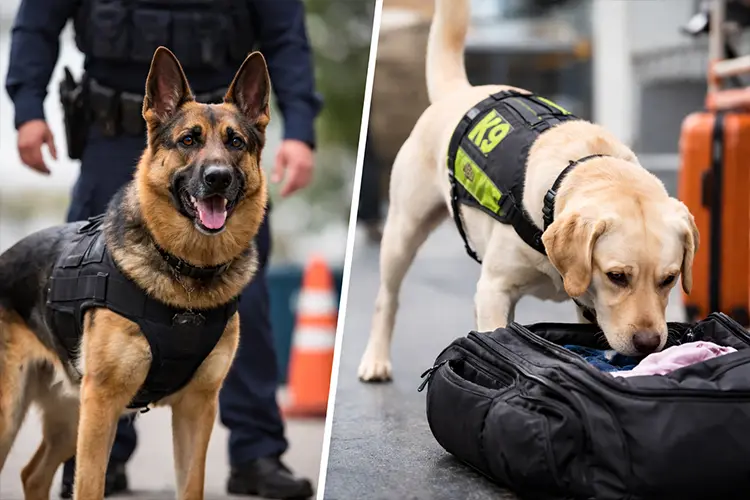
When clients begin exploring K9 security, they often assume all security dog services are essentially the same. In practice, the K9 security sector divides into two distinct disciplines — general purpose dogs and detection dogs — with different training programmes, different operational applications, and different compliance requirements.
Selecting the right type of K9 service matters both for operational effectiveness and for cost efficiency. This guide explains the distinction clearly.
General purpose (GP) security dogs are the most widely deployed category of security dog. They are trained to patrol, deter, detect the presence of individuals, and respond to threats under handler direction.
The core capability of a GP dog is the combination of heightened senses with controlled aggression. These dogs are trained to alert their handler when they detect an intruder, to search buildings and open areas on command, and to respond assertively to direct threats when instructed. They are not trained to target specific substances — their focus is on people and unauthorised presence.
GP dogs excel in environments where the primary threat is unauthorised access, theft, or anti-social behaviour. Their visible presence alone deters the majority of opportunistic intrusions, while their detection capability means that more determined intruders are unlikely to avoid detection.
Detection dogs — sometimes referred to as sniffer dogs — are trained to locate specific target substances using their olfactory capability. Unlike GP dogs, their training is substance-specific. A detection dog trained to locate Class A drugs will alert to the odour signature of those substances; a dog trained for explosives detection will respond to a different set of target odours.
Detection dog training uses a technique called odour imprinting, in which the dog learns to associate the target scent with a positive reward. This process is painstaking and requires considerable time to develop reliably. Handlers working with detection dogs hold specialist qualifications in addition to general K9 handling competencies.
The main categories of detection dog service currently deployed in commercial security contexts include:
The table below summarises the principal differences between GP and detection dogs across the dimensions most relevant to procurement decisions:
In some cases, a dog may hold qualifications in both general purpose handling and a specific detection discipline. However, providers should be transparent about the distinction — a GP dog that has received introductory detection training is not the same as a specialist detection dog with a full, assessed odour library.
For operations where detection is the primary requirement, a specialist detection team should always be deployed. Using a GP team for detection purposes where a specialist is warranted may produce unreliable results and creates liability if a failure to detect has consequences.
Most commercial sites with a general security requirement — theft prevention, trespass, vandalism, unauthorised access — will be best served by a GP K9 patrol. Detection services are most appropriate where the nature of the threat is substance-specific and where a reliable, legally defensible detection result is required.
Many clients deploy both in combination: GP patrols for ongoing perimeter security, with periodic detection operations — for example, a quarterly drug detection sweep of student accommodation — scheduled as part of a broader security programme.
The right K9 service depends on your site, your risk profile, and what you are trying to achieve. If you are primarily concerned with unauthorised access, theft, or vandalism, a general purpose K9 patrol is likely the right starting point. If you have a specific substance detection requirement — drugs in student accommodation, for example — a specialist detection service is what you need.
Veritech provides both general purpose K9 security and NASDU-approved detection dog services. We are happy to talk through your situation honestly and recommend the service that fits, rather than the one that is most profitable for us to sell.
Call: 0800 799 9800 (available 24/7) Email: info@veritech-security.com Or request a consultation online.
Veritech provides both general purpose K9 security and NASDU-approved detection dog services. Contact our team to discuss which service, or combination of services, is right for your site and risk profile.
Related Articles

Head Office
18-20 Millbrook Road East,
Southampton, Hampshire, SO15 1HY
Tel: 0800 799 9800
Email: info@veritech-security.com
Hours: Monday - Sunday: Open 24 Hours

Simply complete our quick survey below
