

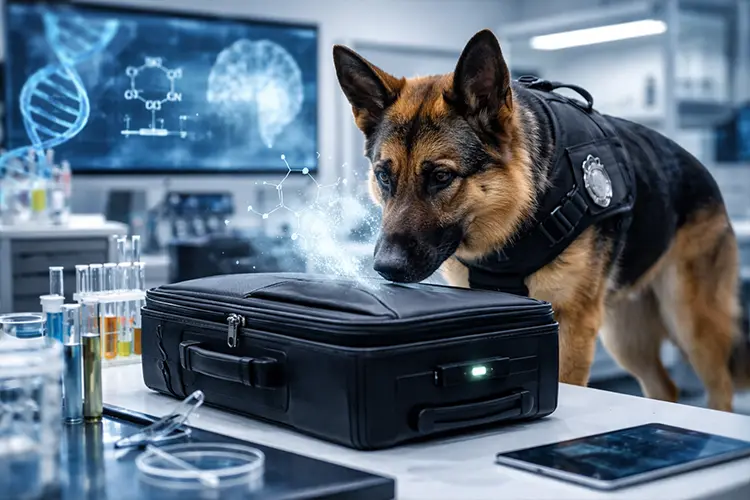
A security dog’s detection capability is not a matter of mystique or marketing — it is grounded in biology that significantly outperforms any technology currently available for field security work. Understanding how dogs detect threats helps clients make more informed decisions about when and why K9 security represents the most effective solution.
The most important distinction between a dog’s nose and a human’s is not just sensitivity — it is specialisation. A dog possesses up to 300 million olfactory receptors in its nose (with an average across breeds of 125–300 million), compared to roughly six million in a human. That alone creates a dramatic difference in raw detection capacity.
However, the more significant factor is how much of a dog’s brain is dedicated to processing scent. The part of the brain devoted to analysing smell is, proportionally, approximately 40 times larger in dogs than in humans. The result is a system designed, from the ground up, to extract detailed information from airborne molecules.
Scientific estimates vary depending on the substance and conditions, but the consensus is that dogs can detect odours at concentrations roughly 10,000 to 100,000 times lower than humans are capable of perceiving. For practical security purposes, this means:
This level of sensitivity makes dogs particularly effective in the environments common to UK commercial security: large open sites, multi-storey buildings, warehouses, and crowded events where visual detection alone is insufficient.
Dogs possess an additional scent-detection organ that humans lack entirely — the vomeronasal organ, commonly known as the Jacobson’s organ. Located in the roof of the mouth, it processes different chemical signals to the main olfactory system, particularly pheromones and chemical compounds associated with stress, aggression, and hormonal states.
This gives security dogs a capability that no electronic sensor can replicate: the ability to detect heightened anxiety or physiological stress in individuals, even when behaviour appears normal. Trained handlers learn to read their dogs’ responses to this stimulus as part of their operational awareness.
While scent detection receives most of the attention, a security dog’s hearing is equally relevant to night patrol and large-site security work. Dogs can hear frequencies between approximately 40 Hz and 60,000 Hz, compared to the human range of roughly 20 Hz to 20,000 Hz.
More practically, dogs can pinpoint the direction and distance of a sound with considerably more precision than humans, and detect sounds at roughly four times the distance a person could hear the same noise. On a large construction site or industrial estate, this translates directly into earlier threat detection and faster response.
Dogs have significantly better low-light vision than humans, owing to a higher proportion of rod photoreceptors in the retina and the presence of a tapetum lucidum — a reflective layer behind the retina that effectively doubles the amount of light available to the eye. While dogs do not see in complete darkness, their low-light capability makes them far more effective than human guards operating in unlit areas.
Dogs also possess superior motion detection. Their visual system is highly attuned to movement, which is relevant to detecting individuals attempting to traverse a site slowly or covertly.
The practical consequence of these biological advantages is significant when translated into security operations:
CCTV and sensor technology has advanced considerably, but it operates differently to a dog. A camera requires a clear line of sight and appropriate lighting. A motion sensor can be triggered by wildlife or environmental factors. Neither can follow a scent trail, detect a concealed person by smell, or respond dynamically to an unfolding situation.
The most effective modern security operations combine both: CCTV monitoring for wide-area coverage and evidence capture, with K9 patrols providing ground-level detection and response capability that technology cannot replicate. These approaches are complementary, not competing.
Understanding the biological basis for canine detection helps explain why a single K9 unit can outperform multiple static guards in many scenarios. It also explains why detection dog services for drugs, explosives, or other substances achieve results that manual searches cannot match.
When evaluating K9 security proposals, the science is the foundation. Training, welfare, and professional standards determine how reliably that biological potential is realised in the field.
The biological advantages covered in this article only translate into reliable security when they are backed by rigorous training, professional deployment, and an experienced handler. A dog’s potential is only as good as the standards of the provider deploying it.
Veritech’s NASDU-certified K9 teams are trained to exploit these natural capabilities in real operational environments — construction sites, vacant properties, student accommodation, and events. Our handlers understand how to read their dogs’ responses and act on them decisively.
Contact us to discuss how K9 security can enhance detection and deterrence on your site.
Call: 0800 799 9800 (available 24/7) Email: info@veritech-security.com Or request a consultation online.
Veritech’s NASDU-certified K9 teams deploy these natural capabilities through rigorous training and professional standards. Contact us to discuss how K9 security can enhance your site’s protection
Related Articles

Head Office
18-20 Millbrook Road East,
Southampton, Hampshire, SO15 1HY
Tel: 0800 799 9800
Email: info@veritech-security.com
Hours: Monday - Sunday: Open 24 Hours

© 2026 Veritech Security is a trading name of Veritech Systems Limited | Company Registration No. 07095234 | Social Responsibility Policy | Sitemap | Privacy Policy | Policies and Procedures | Veritech Systems Limited holds SIA approved contractor status for Security Guarding, CCTV and Keyholding security services.
Simply complete our quick survey below
