
Hiring a CCTV tower for a construction site sounds straightforward until you try to pin down exactly how long you need it. Project timelines shift. Security risks aren’t uniform across a build programme. And no site manager wants to pay for surveillance equipment that’s covering an area that no longer needs it — or, worse, to have removed towers before the real vulnerability window has closed.
This guide helps construction managers, project directors, and site security planners make a more accurate hiring decision — based on actual risk phases rather than rough project duration estimates. If you’re evaluating construction site CCTV services as part of your overall security plan, understanding when coverage is most critical can help you choose the right hire duration.
CCTV tower hire is priced by time. Most providers charge on a weekly or monthly basis, with discounts available for longer commitments. Getting the hire period wrong in either direction has a cost: too short, and you’re either exposed during a high-risk phase or paying premium rates to extend at short notice. Too long, and you’re paying for equipment that’s no longer earning its keep.
Understanding where your real security risks fall across your project programme lets you make a rational hiring decision rather than defaulting to “the length of the project.”
Construction sites don’t carry uniform risk across their whole lifecycle. Security professionals divide a typical build into distinct phases, each with its own threat profile.
Risk level: High
The earliest phase of any construction project tends to be one of the highest-risk periods, for several reasons. There are no structures on site to restrict access. Hoardings and fencing are often incomplete. Valuable plant and equipment — excavators, dumpers, generators — arrives on site before any fixed security infrastructure exists.
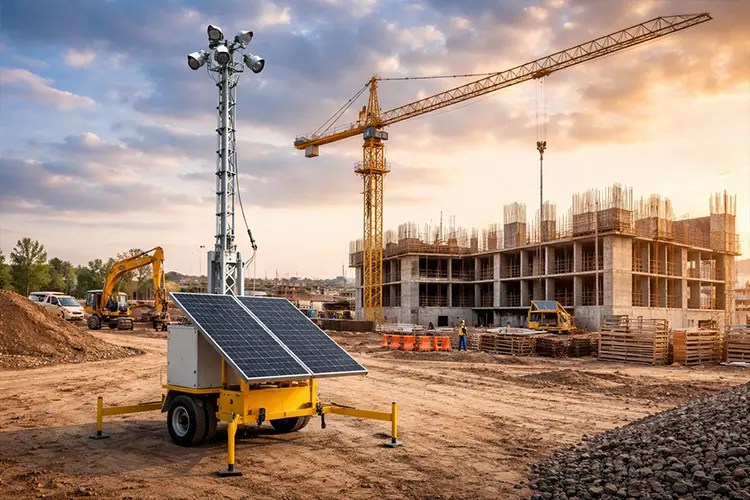
CCTV tower hire should begin here, before plant arrives on site rather than after. A tower visible from the road during the groundworks phase serves as a deterrent signal to opportunist thieves who routinely drive past open sites looking for an easy score.
Recommended hire start: Before first delivery of plant or materials.
Risk level: High to Moderate
During structural frame — whether steel, concrete, or timber — the site contains significant quantities of valuable materials and plant. Access points tend to be better controlled than at groundworks stage, but the site is still largely open. This phase is also associated with elevated risk of cable theft, copper pipework theft, and power tool theft from site cabins.
Tower positioning: Cover plant compounds, material storage areas, and site access points.
Risk level: Moderate, with spikes
Once the building envelope is complete, access is more controlled and the open site risk reduces. However, the introduction of high-value mechanical and electrical materials — copper wiring, HVAC equipment, boilers, specialist tools — creates specific theft targets that require targeted surveillance rather than broad perimeter coverage.
This phase also introduces a new risk: inside jobs. Materials going missing from within the building rather than through perimeter breach are harder to address with external towers alone, and may require either fixed internal cameras or repositioning of external towers to cover delivery and storage areas more closely.
Risk level: Lower
At this stage, the building is largely enclosed, site access is controlled, and the number of workers on site creates a natural deterrent. CCTV towers are typically less critical during this phase unless specific high-value materials warrant coverage. This is often the right point to consider reducing the number of towers on hire.
Risk level: Elevated again
Counterintuitively, the period approaching and immediately following practical completion is associated with increased risk. The main contractor’s workforce has largely dispersed. Site cabins and compounds are being cleared. Access controls become more relaxed as the handover process begins. Finished goods — kitchens, sanitaryware, appliances, flooring — are attractive targets that were not present earlier in the project.
This phase also includes the period between handover and occupation, when a building may be fully finished but unoccupied. This is a period of meaningful vulnerability that CCTV tower hire should not have already ended by.
Recommended hire end: Not before the building is occupied or a permanent security solution is in place.
Theft and trespass on construction sites follows a seasonal pattern that should influence your hiring decisions.
The Christmas and New Year shutdown is consistently the highest-risk period of the year for construction site security. Sites are typically unoccupied for between one and three weeks. Workers and contractors are absent, removing the natural deterrent of site activity. Opportunist thieves are well aware of this window and plan accordingly.
If your project is live across December and January, this is not the period to reduce tower numbers or allow a hire contract to lapse. If anything, adding temporary coverage during the shutdown is a standard recommendation from construction site security specialists.
Summer weekends on long-running projects also see elevated incident rates, particularly for metal theft and fly-tipping, with the longer daylight hours giving thieves more working time on site.
Most professional CCTV tower hire providers offer minimum contracts of four weeks, with rolling monthly extensions. Some providers offer project-based contracts that fix a rate across the anticipated project duration in exchange for a longer commitment.
Before signing a hire agreement, check:
Repositioning flexibility. Can towers be moved to different areas of the site as your security priorities change, and if so, is there a charge?
Early termination provisions. If your project completes ahead of schedule, can you return equipment without penalty?
Extension lead times. If you need to extend a hire at short notice — for example, because of a project delay — how quickly can that be confirmed?
Emergency deployment. If a security incident occurs mid-project and you need an additional tower rapidly, what is the provider’s deployment time?
Rather than trying to estimate total project duration precisely, consider structuring your hire in phases aligned to risk:
This approach gives you coverage where it matters most, reduces cost during lower-risk phases, and avoids the trap of under-insuring during the project’s most vulnerable moments.
Getting hire duration wrong is one of the most common — and most avoidable — construction security mistakes. Veritech Security works with your project programme to structure CCTV tower hire around your actual risk phases, so you’re covered when it matters and not paying for equipment when you don’t need it.
We offer flexible hire terms, rapid deployment for emergency situations, and the ability to add or reposition towers as your project evolves. If your programme changes, we’ll work with you to adjust — without the penalty charges that catch contractors out with other providers.
Call: 0800 799 9800 (available 24/7) Email: info@veritech-security.com Or request a free site survey online.
Related Articles

Head Office
18-20 Millbrook Road East,
Southampton, Hampshire, SO15 1HY
Tel: 0800 799 9800
Email: info@veritech-security.com
Hours: Monday - Sunday: Open 24 Hours

© 2026 Veritech Security is a trading name of Veritech Systems Limited | Company Registration No. 07095234 | Social Responsibility Policy | Sitemap | Privacy Policy | Policies and Procedures | Veritech Systems Limited holds SIA approved contractor status for Security Guarding, CCTV and Keyholding security services.
Simply complete our quick survey below
