
When you hand over the keys to your premises to a security provider, you are placing a significant degree of trust in that company and the individuals it employs. Understanding the regulatory framework that governs key holding — and specifically what a key holding licence is and what it requires — puts you in a much stronger position to evaluate whether the provider you are considering is operating to the correct professional standard. Veritech Security’s key holding service operates within this framework as an SIA Approved Contractor.
Key holding in the UK is regulated by the Security Industry Authority (SIA), the government-appointed regulator of the private security industry operating under the Private Security Industry Act 2001. The SIA exists to raise standards across the sector, license individuals working in security roles, and operate the Approved Contractor Scheme (ACS) — the quality standard for security companies.
The SIA’s licensing regime covers several distinct categories of security work. Key holding is its own licence type — separate from security guarding, door supervision, close protection, and the other manned guarding licences.
The SIA issues a specific key holding licence, which authorises an individual to hold keys and access credentials for a property and to use them when responding to activations or authorised access requests. Importantly, the key holding licence does not require a formal licence-linked training qualification — unlike security guarding or door supervision licences, which do.
However, there is an important practical distinction. If the activities carried out during a key holding response include what the SIA defines as manned guarding — physically inspecting premises, guarding against intrusion, or carrying out security patrols — the officer additionally requires a security guarding or door supervision licence. Since professional alarm response typically involves exactly these activities, reputable key holding providers deploy officers who hold both a key holding licence and a security guarding or door supervision licence.
Non-front-line roles typically involve managing or supervising people who are performing licensable activities. A control room manager who directs licensed officers, or a security operations manager who oversees guarding teams, may operate under a non-front-line licence.
The practical implication for you as a client: confirm that your provider’s officers hold current, valid SIA licences appropriate to the activities they will carry out. An officer performing a full internal inspection of your premises should hold a security guarding licence, not merely a key holding licence. Any provider using unlicensed individuals for these activities is operating illegally.
For officers who also perform manned guarding activities during key holding responses, the SIA security guarding licence requires:
Meeting the vetting standard. All SIA licence applicants are subject to criminal record checks (covering both spent and unspent convictions), identity verification, and a right-to-work check. The baseline vetting standard for security industry workers is set out in BS 7858, which covers employment history verification going back a minimum of five years.
Holding a recognised qualification. Security guarding applicants must complete an SIA-approved training qualification that includes units covering conflict management, fire safety, first aid, and the law as it applies to security professionals.
Applying and maintaining the licence. Licences are applied for directly with the SIA, are valid for three years, and must be renewed. An expired licence is equivalent to no licence.
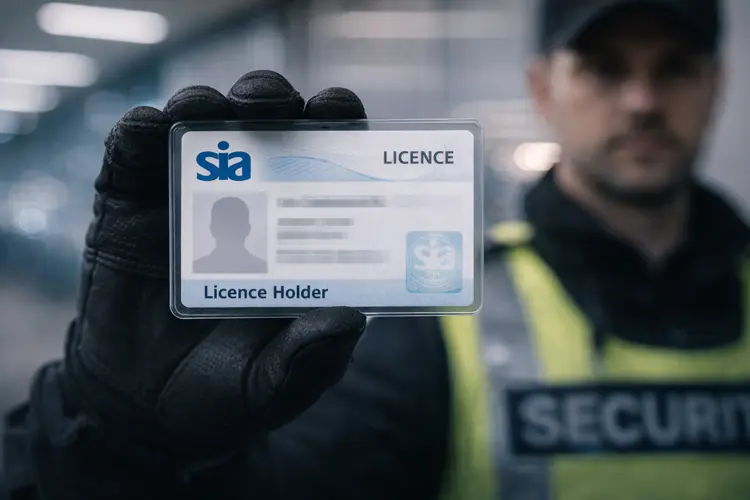
Carrying their licence. SIA-licensed officers carry a photocard licence displaying their photograph, name, licence type, and expiry date. You are entitled to ask any officer attending your premises to produce this card for inspection. If they cannot, they should not be working.
Beyond individual officer licensing, the SIA operates the Approved Contractor Scheme — a quality standard for security companies rather than individuals. ACS approval is awarded to companies that meet stringent criteria across management, training, deployment standards, health and safety, and service quality.
ACS approval is not a legal requirement for a security company to trade. However, it represents a meaningful quality mark — one that demonstrates independent oversight and accountability. For clients, specifying an SIA ACS-approved key holding provider gives assurance that the company has been evaluated against an objective standard, not merely that its individual officers hold licences.
There is an important distinction here. A company can employ SIA-licensed officers and still be a poor-quality operator if there is no oversight of how those officers are managed, trained, deployed, and supervised. ACS approval closes that gap.
For environments where the standard SIA licence and BS 7858 vetting is insufficient — government facilities, defence contractors, critical national infrastructure, data-sensitive sites — Security Check (SC) clearance provides an additional layer of vetting that goes considerably beyond the SIA standard.
SC clearance is administered by the UK Security Vetting (UKSV) agency and involves financial checks, a full security questionnaire review, and a check against national intelligence holdings. Not all key holding providers can deploy SC Cleared officers — it is a relatively specialist capability.
When evaluating a key holding provider, the following questions will quickly establish whether they are operating to the correct standard:
Veritech Security holds SIA Approved Contractor status for the provision of security guarding, key holding, and CCTV services — independently verified against the SIA’s quality standards. Every officer involved in our key holding service holds current, valid SIA licences appropriate to the activities they perform, and SC Cleared officers are available for clients operating in sensitive or restricted environments.
Our services relevant to licensed key holding include SIA-licensed and SC Cleared alarm response; 24/7 control room monitoring by trained operators; secure key storage in SIA-compliant controlled facilities; and full incident reporting and documentation for every attendance.
We hold SIA approved contractor status alongside ISO 9001, ISO 14001, Constructionline, SafeContractor, RISQS, Achilles, and Cyber Essentials accreditations — the credentials that demonstrate our regulatory compliance to clients and their insurers.
If you want to verify the credentials of your current key holding provider — or find out whether Veritech is the right replacement — speak to our team today.
Call: 0800 799 9800 (available 24/7) Email: info@veritech-security.com Or request a key holding consultation online.
Related Articles

Head Office
18-20 Millbrook Road East,
Southampton, Hampshire, SO15 1HY
Tel: 0800 799 9800
Email: info@veritech-security.com
Hours: Monday - Sunday: Open 24 Hours

© 2026 Veritech Security is a trading name of Veritech Systems Limited | Company Registration No. 07095234 | Social Responsibility Policy | Sitemap | Privacy Policy | Policies and Procedures | Veritech Systems Limited holds SIA approved contractor status for Security Guarding, CCTV and Keyholding security services.
Simply complete our quick survey below
