
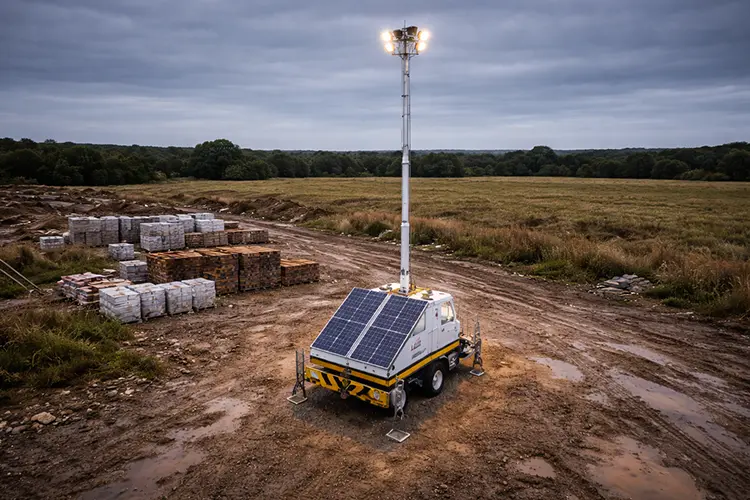
The absence of reliable power is one of the defining challenges of construction site security. In the early phases of any project, mains electricity may be months away from connection. In remote locations — infrastructure works, agricultural developments, rural housing schemes — mains power may never be available at all. Solar-powered CCTV towers are designed precisely for these conditions. Veritech’s mobile CCTV tower service includes solar and hybrid-powered options, deployed to sites across the UK where traditional power infrastructure is absent or unreliable.
A CCTV tower that loses power provides no surveillance, no deterrence, and no monitoring. For construction sites, where intrusions predominantly occur at night and over weekends, a system that shuts down or degrades during these periods provides security for the wrong hours.
The power supply design of a mobile CCTV tower is therefore not a background technical detail. It is one of the most important factors determining whether the system actually protects your site. A solar system that is correctly specified for your location and camera load will operate continuously and reliably. A system that has been undersized to reduce hire costs may fail during the periods when you need it most.
A solar-powered CCTV tower combines three components: solar panels to generate power during daylight hours, a battery bank to store that power for use at night, and a charge controller to manage the relationship between them.
The solar panels convert sunlight into electrical charge. The UK experiences significant seasonal variation in solar generation — daylight runs to sixteen or seventeen hours in June but only seven or eight in December, and the sun’s lower winter angle reduces the intensity of irradiance considerably. A correctly sized system accounts for this by carrying enough battery capacity to bridge the low-generation winter periods without interruption, rather than relying on consistent daily solar input.
A well-engineered system for a CCTV tower carrying a camera, 4G communications module, and audio speaker draws approximately 20 to 30 watts continuously. A battery bank of four 130Ah 12V batteries holds around 6.24kWh of capacity. Even accounting for recommended depth of discharge limits, this is sufficient to run the system for three to four days without any solar input — covering a typical UK cloudy period comfortably.
The charge controller protects the batteries from overcharging and from excessive discharge, extending battery lifespan and maintaining system reliability. On a quality system, this component operates automatically and requires no site management.
The most common concern about solar-powered CCTV is performance during the UK’s predictably cloudy winters. This concern is legitimate if the system is undersized, and unfounded if it is correctly specified.
Solar panels continue to generate charge in diffuse (cloudy) light — at reduced efficiency, but continuously. The safety margin lies in the battery bank size. A correctly sized battery bank does not rely on full solar input every day — it relies on an average over time, with enough stored capacity to bridge gaps. For UK construction site deployments, a four-battery configuration of the type described above provides this margin with comfortable headroom.
If a supplier cannot confirm the solar panel rating and battery bank capacity of their towers, that is a significant warning sign. Generic claims of “solar powered” without specification data should be tested with specific questions.
Solar is the right default choice for most construction site CCTV tower deployments, particularly in the early project phases. However, it is not the only option, and on some sites a different configuration is more appropriate.
Mains-connected towers draw power from a site’s temporary electrical supply. Where this supply is reliable and the deployment location is fixed, mains power provides unlimited continuous operation without any dependency on sunlight or battery management. It is well-suited to later project phases when services are connected and the site layout is more settled.
Hybrid systems — solar-primary with a mains fallback — offer the flexibility of solar deployment with the reliability assurance of a mains backup. When solar input is insufficient, the system switches automatically to mains. This configuration is particularly valuable on sites where a temporary supply exists but is not fully reliable, or where the deployment location may move during the project.
Certain site types make solar power not just preferable but essential:
In all of these contexts, a solar-powered CCTV tower is not a compromise — it is the purpose-designed solution. The technology exists specifically to provide professional-grade surveillance without any grid dependency.
Before committing to a solar-powered CCTV tower hire, ask your supplier the following:
Power supply is one of several critical factors in choosing the right tower. For a full assessment of all the criteria to apply, see our guide to what to look for when hiring a mobile CCTV tower for a construction site. And for context on why these systems are increasingly central to construction site security strategy, see our guide on how mobile CCTV towers reduce construction site theft.
Veritech Security works with principal contractors, project managers, and construction businesses across the UK to deploy, monitor, and manage mobile CCTV tower solutions that protect sites from groundworks through to handover.
Our services relevant to mobile CCTV towers and construction site security include solar and hybrid-powered mobile CCTV towers for construction sites across the UK — including sites with no mains power connection; NSI Gold-accredited 24/7 remote monitoring with live audio deterrence and verified police response; free site surveys assessing power options, coverage requirements, and risk profile before any hardware is committed; and flexible hire terms covering early groundworks through to project completion, with repositioning as your site develops.
We hold SIA Approved Contractor status alongside ISO 9001, ISO 14001, Constructionline Platinum, SafeContractor, RISQS, Achilles, and Cyber Essentials accreditations — the credentials that principal contractors and their insurers expect to see.
If you have a construction project that needs mobile CCTV coverage, speak to Veritech before the plant goes on site.
Call: 0800 799 9800 (available 24/7) Email: info@veritech-security.com Or request a free site survey online.

Head Office
18-20 Millbrook Road East,
Southampton, Hampshire, SO15 1HY
Tel: 0800 799 9800
Email: info@veritech-security.com
Hours: Monday - Sunday: Open 24 Hours

© 2026 Veritech Security is a trading name of Veritech Systems Limited | Company Registration No. 07095234 | Social Responsibility Policy | Sitemap | Privacy Policy | Policies and Procedures | Veritech Systems Limited holds SIA approved contractor status for Security Guarding, CCTV and Keyholding security services.
Simply complete our quick survey below
