

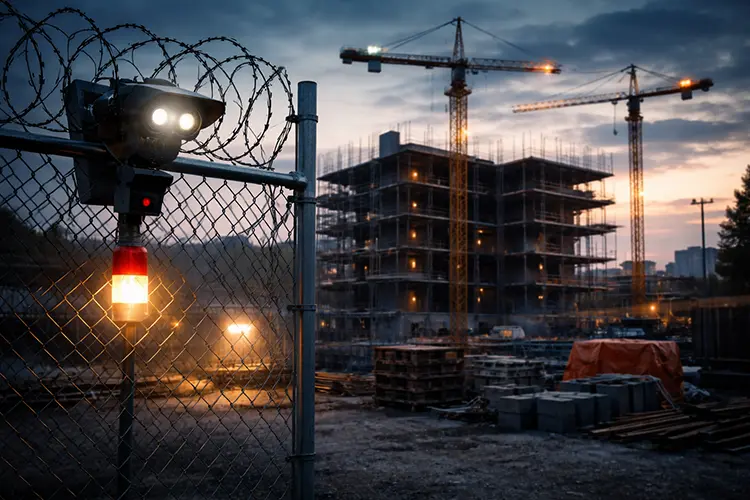
Project shutdowns are a routine part of construction. A Christmas close-down. A dispute that pauses groundworks. A planning delay between phases. A remediation period that stretches longer than expected. In each case, the site empties out — and almost immediately, a different kind of problem starts.
Vacant construction sites are among the most targeted locations in the UK. Without the deterrent of workers, vehicles, and activity, criminal intelligence quickly identifies them as low-risk, high-reward opportunities. Equipment left unattended. Materials stockpiled and unsecured. Perimeter fencing that was adequate during the working day but hasn’t been checked since the last crew departed.
The numbers reflect this. Industry data consistently shows that theft incidents spike during site shutdown periods, with the Christmas and new year period producing some of the highest single-event loss figures in the construction calendar. Organised criminal groups actively monitor sites to identify the moment active work stops.
The irony is that many contractors plan extensively for security during active construction phases, then treat the shutdown period as an afterthought. That’s where the most expensive losses tend to occur.
This guide covers what makes vacant sites uniquely vulnerable, what the legal obligations are during shutdown periods, and what professional construction site security looks like when a site goes dark.
A working construction site has significant passive security built in. People arrive early, leave late, and are present throughout the day. Subcontractors come and go. Deliveries happen. The site is active and visible. For an opportunist or even an organised criminal, targeting an active site means accepting a materially higher chance of being seen.
An empty site offers none of those deterrents.
What it does offer — particularly in the early and intermediate phases of construction — is open access to significant value: plant machinery, generators, copper cabling, tools, fuel, and construction materials that represent hundreds of thousands of pounds of assets with minimal protection beyond a padlock.
Several factors compound the vulnerability of vacant sites specifically.
Extended windows of opportunity. A weekend shutdown is 60+ hours without active site presence. A Christmas close-down is commonly two to three weeks. That’s not a brief gap in coverage — it’s a sustained period in which organised criminal networks have ample time to survey, plan, and execute.
Reduced neighbourhood awareness. A site that has been active for months, then suddenly goes quiet, rarely triggers concern in the surrounding area. The change is normalised. There’s no collective sense that something unusual is happening when a van pulls up at midnight.
Deteriorating perimeters. Active construction constantly disrupts perimeter integrity. Ground movement, deliveries, vehicle access, and general activity mean fencing is regularly shifted, gated, and re-established. A site that was adequately secured on the last working day may have gaps, dislodged panels, or compromised sections that weren’t prioritised before closedown.
Squatting and trespass. Beyond theft, vacant construction sites frequently attract rough sleepers and groups engaging in anti-social behaviour. This creates compounding risks: liability if a trespasser is injured, insurance complications, and the escalating damage that follows when a site becomes known as accessible.
Arson. A risk that is significantly elevated on vacant and isolated sites. Whether targeted or opportunistic, a single arson incident on a vacant site can result in losses that dwarf anything theft alone would produce — and the subsequent investigation delays are measured in months, not days.
Many contractors assume that CDM obligations only apply while the site is active. They do not. The Construction Phase Plan and the associated site management duties continue throughout the construction phase — and that includes any shutdown or planned pause period.
CDM Regulation 18 requires construction sites to be kept in good order and, so far as is reasonably practicable, to have their perimeter identified by suitable signs and/or be fenced off in the interests of health and safety. That duty is assessed against the level of risk. It does not switch off when the last worker leaves on Friday afternoon.
This has direct practical consequences. If a trespasser is injured on a vacant construction site during a shutdown period, and it can be demonstrated that reasonable precautions to prevent access were not taken and maintained, the liability exposure is identical to an incident during active work. “The site was closed” is not a defence. “We maintained proportionate security measures appropriate to the risk” is.
Insurers are similarly unsympathetic to claims arising from shutdown periods where security was allowed to lapse. A policy that provides coverage during active construction may contain specific conditions around vacant site protection — conditions that are easy to satisfy during an active phase but actively neglected during a shutdown.
Understanding those policy conditions before a shutdown period, not after a claim is refused, is a straightforward way to avoid a very expensive lesson.
The security approaches that work well during an active construction phase don’t always translate directly to vacant site protection. The priorities and practical constraints are different.
Mains power is often unavailable. Many temporary security systems rely on power connectivity that simply doesn’t exist on an early-phase or shut-down site. Security solutions that operate independently of mains power — solar-powered CCTV towers, battery-backed alarm systems, self-contained perimeter detection — are essential.
The site layout may be incomplete. A site midway through a multi-phase development may lack the defined perimeters and controlled access points that make security straightforward on a completed site. Protecting a partially built environment requires adaptive approaches.
Response times matter more. On an active site, potential incidents are often detected quickly because people are present. On a vacant site, the first detection often comes via remote monitoring — and what happens in the minutes following that detection determines whether an incident is intercepted or simply recorded after the fact.
Access needs don’t disappear entirely. Even during shutdown periods, authorised access requirements continue. Inspectors, maintenance contractors, insurers, and surveyors all need controlled, documented access. Security arrangements must accommodate legitimate access without compromising the integrity of the perimeter.
Professional vacant site security is built around a layered approach that addresses deterrence, detection, and response — each layer compensating for the limitations of the others.
Perimeter integrity and physical deterrents. The foundation of vacant site protection is a perimeter that is genuinely difficult to breach and that visibly signals active security. This means regular inspection and maintenance of fencing — not just on the final day before shutdown, but at defined intervals throughout the closure period. Concrete barrier blocks can supplement fencing in particularly vulnerable sections or at vehicle access points. Security signage indicating active monitoring is itself a deterrent with documented effectiveness.
Autonomous CCTV and remote monitoring. Mobile CCTV towers are one of the most effective tools for vacant site protection precisely because they operate independently of mains power and can be repositioned to reflect the most current risk areas of the site. Mounted on telescopic masts with solar charging and 4G connectivity, they provide continuous HD footage with motion-triggered alerts fed directly to a monitoring centre. The key distinction from basic CCTV recording is active monitoring: a staffed alarm receiving centre that assesses triggered alerts in real time and escalates to police or response teams where a genuine incursion is confirmed.
Perimeter intrusion detection. Wireless perimeter detection systems extend coverage beyond camera fields of view, creating a detection boundary around the entire site perimeter. Systems that cover significant distances per unit, with no cabling requirements, are well suited to the constraints of vacant construction sites. Integration with the CCTV monitoring feed means alerts are immediately contextualised with visual confirmation.
Battery-powered alarm systems. Construction site alarm systems designed specifically for environments without mains power provide motion-triggered audio deterrents and remote notifications. The combination of a physical alarm activation and a direct notification to site management and a monitoring centre creates a response chain that compresses the window available to intruders.
Scheduled inspections. Technology alone cannot substitute for physical inspection. Professional vacant site security programmes include documented, scheduled site visits that check perimeter integrity, identify and address maintenance issues, and provide a physical presence that reinforces the deterrent signal. These inspections also create the documented record of ongoing security management that is essential for CDM compliance and insurance purposes.
Access control maintenance. Even with no active workforce, controlled access points must remain operational and documented. Keyholding services ensure that legitimate access requirements are handled securely and recorded, and that emergency response to alarm activations can be coordinated without delay.
Most construction project insurance policies include provisions specifically relating to site security during shutdown and vacancy periods. These provisions are worth reading carefully, because many contractors discover them for the first time when a claim is in dispute.
Common conditions include requirements that CCTV is operational and monitored during periods of vacancy, that physical security measures meet minimum specified standards, and that the insurer is notified when a planned shutdown exceeds a certain duration. Failure to comply with these conditions can result in partial or total claim rejection — a position that is difficult to recover from when losses are significant.
Working with a professional security provider that can provide documented evidence of the measures in place — monitoring logs, inspection records, alarm activation data — creates the audit trail that supports claims and satisfies insurer conditions. It also significantly strengthens the position of principal contractors in any dispute arising from incidents during shutdown periods.
The most common mistake in vacant site security is treating it as something to arrange after the decision to shut down. By that point, the window to plan and deploy proportionate measures is compressed, and the risk window is already opening.
Effective vacant site security planning starts as part of the project’s overall Construction Phase Plan, with specific provisions for scheduled and unscheduled shutdown periods. It includes a pre-shutdown security audit to confirm perimeter integrity, document the state of access points, and identify any gaps created by recent construction activity. It includes confirmation that monitoring systems are operational and that response chains are established. And it includes clear documentation of the security arrangements in place — for CDM purposes, for insurers, and for the simple practical reason that it creates accountability.
If you’re approaching a shutdown period without a clear vacant site security plan in place, the time to act is now — not after the site goes quiet.
Veritech Security provides specialist vacant site protection across the UK, with solutions designed specifically for the constraints and risk profile of sites without an active workforce.
Our vacant site security services include deployment of solar-powered mobile CCTV towers with NSI Gold-certified 24/7 monitoring, wireless perimeter intrusion detection, battery-powered alarm systems with remote notification, scheduled physical inspections with documented records, access control and keyholding, and construction site security risk assessment covering shutdown periods specifically.
All services are backed by our SIA-approved contractor status, ISO 9001 and ISO 14001 accreditations, and a 24/7 control room staffed by trained security professionals.
If your site is approaching a shutdown or is currently vacant, speak to Veritech before the risk window opens.
Call: 0800 799 9800 (available 24/7) Email: info@veritech-security.com Or request a consultation online.
Veritech Security is an SIA-approved contractor holding ISO 9001, ISO 14001, Constructionline, SafeContractor, RISQS, and Achilles accreditations. We provide construction site security to principal contractors, housebuilders, and infrastructure projects across the UK.

Head Office
18-20 Millbrook Road East,
Southampton, Hampshire, SO15 1HY
Tel: 0800 799 9800
Email: info@veritech-security.com
Hours: Monday - Sunday: Open 24 Hours

© 2026 Veritech Security is a trading name of Veritech Systems Limited | Company Registration No. 07095234 | Social Responsibility Policy | Sitemap | Privacy Policy | Policies and Procedures | Veritech Systems Limited holds SIA approved contractor status for Security Guarding, CCTV and Keyholding security services.
Simply complete our quick survey below
