

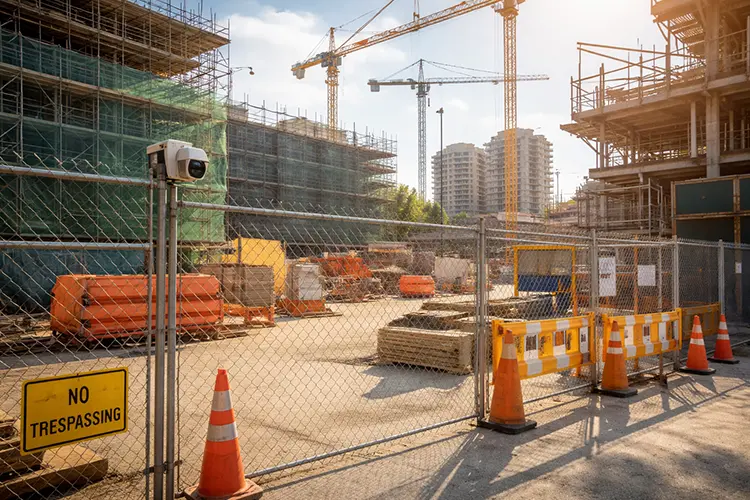
Most construction site managers are well versed in the obligations they have towards their workforce. Risk assessments, inductions, PPE, method statements — the internal safety framework of a construction project is well developed, well documented, and regularly audited.
What receives less systematic attention is the duty of care that extends to people who have nothing to do with the project at all: members of the public passing the site boundary, pedestrians navigating around hoardings, children who might be attracted to the visual interest of a build, residents in adjacent properties, and anyone whose daily routine brings them within reach of construction activity.
This duty is not aspirational. It is legal, enforceable, and — when things go wrong — capable of producing outcomes that are genuinely serious for contractors, principal contractors, and the companies behind them.
Understanding what it actually requires, and how professional construction site security supports compliance, is the starting point for managing it effectively.
The duty to protect the public during construction projects draws on several overlapping pieces of legislation, each of which creates distinct obligations.
CDM Regulations 2015 — Regulation 18. Regulation 18 (Good order and site security) requires that where necessary in the interests of health and safety, a construction site must, so far as is reasonably practicable, have its perimeter identified by suitable signs and be arranged so that its extent is readily identifiable, or be fenced off. The standard applied — so far as is reasonably practicable — is assessed against the level of risk. A site adjacent to a school or busy pedestrian route carries a demonstrably different risk profile to a remote commercial development, and the measures expected to satisfy the standard reflect that.
Health and Safety at Work Act 1974 — Section 3. Section 3 extends the general duty of care explicitly to non-employees who may be affected by work activities. For a construction project, this encompasses anyone in the vicinity of the site whose safety could be affected by the activities taking place. The duty is broad and applies to members of the public, visitors, and anyone else who may be affected — not only people with a formal connection to the site.
Occupiers’ Liability Act 1984. This is the piece of legislation that surprises contractors most. Even when a person enters construction land without permission — a trespasser — the occupier may still owe them a duty of care if they were aware of a danger on the land and the trespasser’s presence was foreseeable. The case law on child trespassers is particularly well developed. A gap in perimeter fencing adjacent to a school or residential area is not a neutral fact. It is a foreseeable route of access with foreseeable consequences, and courts have consistently applied the 1984 Act in those circumstances.
Common law negligence. Beyond the statutory framework, common law negligence principles apply. If a member of the public suffers harm as a result of a construction project, and it can be established that the harm was foreseeable and that the contractor failed to take reasonable steps to prevent it, a civil claim follows — regardless of whether criminal prosecution is also pursued.
The cumulative effect of this framework is that contractors carry a substantial, multi-layered obligation to protect people who are not their employees and who they may never directly encounter. Meeting that obligation requires more than good intentions.
Understanding what the duty of care is protecting against helps clarify what adequate protection actually looks like.
Unauthorised site entry. The most acute risks arise when members of the public — most commonly children and young people — access construction sites without authorisation. Excavations, unstable structures, scaffolding, and plant machinery create hazards that are immediately dangerous to anyone without construction site training. Incidents involving trespassers on construction sites result in serious injuries and fatalities each year in the UK.
Boundary zone hazards. Not every public safety risk requires someone to physically enter the site. Materials stored close to or overhanging the public boundary, scaffolding that creates overhead risks on adjacent footpaths, construction traffic on public roads, and noise, dust, and vibration affecting neighbouring occupants all fall within the duty of care — and all require active management rather than passive hope that nothing goes wrong.
Temporary diversions and pedestrian management. When construction activity requires the temporary closure or diversion of pedestrian routes, the contractor assumes responsibility for the safety of those routes. Inadequately signed or maintained diversions, temporary structures that create trip hazards, or diversions that channel pedestrians into genuinely unsafe routes are all sources of liability.
Emergency access. Construction sites create physical constraints on the surrounding environment. The duty to protect the public extends to ensuring that emergency access and egress routes in the surrounding area are not compromised by site activity or temporary structures.
The consequences of inadequate site security that allows public access are clearly evidenced in HSE enforcement action.
In a case prosecuted by the HSE, a company was fined £600,000 for breaches of the Health and Safety at Work Act 1974 and CDM Regulations 2015. The company was in control of a housing development site adjacent to busy pedestrian footpaths. A seven-year-old child accessed the site through inadequate perimeter fencing and became trapped in a drainage pipe, where he remained overnight and suffocated. The HSE found that at some sections of the site, fencing was non-existent; at others, it was well below the required height. The company had failed to ensure sufficient fencing was in place or to adequately monitor and maintain the perimeter.
Following the case, the HSE stated: “The dangers to children gaining access to construction sites and treating them like a playground is an ongoing problem which must be addressed at all types of sites. The industry must do all it can to ensure children can’t access construction sites and be exposed to the inherent risks.”
Where fatalities arising from inadequate site control involve more serious management failures, the Corporate Manslaughter and Corporate Homicide Act 2007 may be engaged. Under the 2016 Sentencing Council guidelines, corporate manslaughter fines range from £180,000 to £20 million depending on the size of the organisation. Individual directors remain exposed to prosecution under health and safety legislation and, in serious cases, to imprisonment under gross negligence manslaughter. These are not theoretical outcomes — the HSE enforcement register documents cases across all of these categories.
In enforcement cases and civil litigation, the same patterns appear repeatedly. Understanding them is the practical starting point for avoiding them.
Perimeter gaps and maintenance failures. A site that is well-fenced at mobilisation but inadequately maintained throughout the project is a site whose perimeter is gradually degrading. Construction activity, deliveries, and ground movement all affect fencing integrity. Without a systematic inspection and maintenance regime, gaps develop — and they tend to be discovered either by HSE inspectors or by the incident that follows a trespass.
Inadequate lighting. Poor lighting at and around site boundaries is a recurring factor in both trespass incidents and accidents involving members of the public in proximity to the site. The duty to protect the public does not switch off at dusk.
Insufficient signage. Clear, well-positioned signage does two things: it communicates hazards to people approaching the site boundary, and it provides documented evidence that appropriate warnings were given. Sites with inadequate, outdated, or obscured signage are harder to defend in enforcement or litigation contexts.
Unmanaged construction traffic. Construction vehicle movements on public roads represent a significant interface between site activity and public safety. Sites that lack effective traffic management — flagging arrangements, banksmen at crossing points, clear speed and routing protocols — create foreseeable risks that the duty of care requires to be addressed.
The out-of-hours gap. The majority of trespass incidents occur outside working hours, when active supervision has ended. Sites that rely on passive physical barriers alone, without monitoring, detection, or response capabilities, are most vulnerable during the period when the duty of care is hardest to actively enforce. A fence is not the same as security.
The practical measures required to protect members of the public substantially overlap with the security measures that protect site assets. This is not coincidental — both objectives require the same underlying capabilities: perimeter integrity, detection, monitoring, and response.
Perimeter security and access control. Robust perimeter fencing with regular inspection and documented maintenance records addresses both CDM Regulation 18 compliance and the Occupiers’ Liability Act duty. Where particular risks exist — proximity to schools, high-pedestrian areas, or sites with a history of unauthorised access — concrete barrier blocks, anti-climb measures, and monitored access control systems provide the elevated level of protection that the risk profile requires.
CCTV and remote monitoring. Construction site CCTV with active monitoring does something that passive recording cannot: it creates the ability to identify a potential public safety incident and respond before harm occurs, rather than simply providing evidence afterwards. When a perimeter breach is detected, a monitored response — whether an audio challenge, an alert to on-site response teams, or a police call — can intercept the incident in its early stages.
Manned guarding. For sites adjacent to high-footfall public areas, or where the public safety risk profile is elevated by the nature of the works, manned guarding provides the visible, human deterrent and active response capability that technology alone cannot replicate. Security officers can manage pedestrian interactions at site boundaries, enforce exclusion zones, and respond immediately to developing situations.
Lighting and signage management. Ensuring that boundary lighting is maintained and that signage is current, well-positioned, and compliant with relevant standards is a straightforward but often neglected element of public safety management. Including it within a professional security provider’s scope creates accountability and documentation.
Documentation and evidence. Across all of these measures, professional security provision creates the documented audit trail — inspection logs, monitoring records, incident reports — that is essential both for demonstrating ongoing compliance and for defending against claims in the event of an incident.
Conduct a specific public safety risk assessment. The Construction Phase Plan security risk assessment should include a specific analysis of how members of the public could be affected by site activity or could access the site without authorisation. This assessment should be reviewed when site conditions change materially — not just at mobilisation.
Establish a perimeter inspection regime. Fencing and barrier inspection should be a scheduled, documented activity throughout the project — not something that happens informally when someone notices a problem. Define the frequency, the responsible person, and the reporting format.
Review your out-of-hours arrangements. If your current security provision leaves a meaningful gap between the last worker leaving and the first worker arriving, that gap requires explicit mitigation. Passive barriers are not sufficient where a foreseeable public safety risk exists.
Understand your insurance conditions. Public liability insurance policies typically contain conditions that relate to site security and public safety measures. Understand what yours require and confirm that your current arrangements satisfy them.
Work with a specialist security provider. The complexity of managing CDM obligations, Occupiers’ Liability Act duties, and general public safety requirements across the lifecycle of a construction project is not trivial. A specialist security provider brings the expertise, technology, and documentation infrastructure to manage that complexity systematically — and provides the evidence base that matters when compliance is scrutinised.
At Veritech Security, we provide construction site security solutions that specifically address the public safety duties that CDM 2015 and the broader legal framework impose on principal contractors and developers.
Our services include perimeter security design and installation with ongoing maintenance and inspection programmes, construction site CCTV with NSI Gold-certified 24/7 monitoring, manned guarding and mobile patrols for public-facing site boundaries, access control and visitor management, and full documentation and reporting to support CDM compliance and insurer requirements.
We work with principal contractors, infrastructure project teams, and housebuilders across the UK, and hold SIA-approved contractor status alongside ISO 9001, ISO 14001, Constructionline, SafeContractor, and RISQS accreditations.
If you have concerns about your site’s public safety security arrangements, speak to Veritech before the risk becomes a liability.
Call: 0800 799 9800 (available 24/7) Email: info@veritech-security.com Or request a consultation online.
Veritech Security is an SIA-approved contractor holding ISO 9001, ISO 14001, Constructionline, SafeContractor, RISQS, and Achilles accreditations. We provide construction site security to principal contractors, housebuilders, and infrastructure projects across the UK.

Head Office
18-20 Millbrook Road East,
Southampton, Hampshire, SO15 1HY
Tel: 0800 799 9800
Email: info@veritech-security.com
Hours: Monday - Sunday: Open 24 Hours

© 2026 Veritech Security is a trading name of Veritech Systems Limited | Company Registration No. 07095234 | Social Responsibility Policy | Sitemap | Privacy Policy | Policies and Procedures | Veritech Systems Limited holds SIA approved contractor status for Security Guarding, CCTV and Keyholding security services.
Simply complete our quick survey below
