

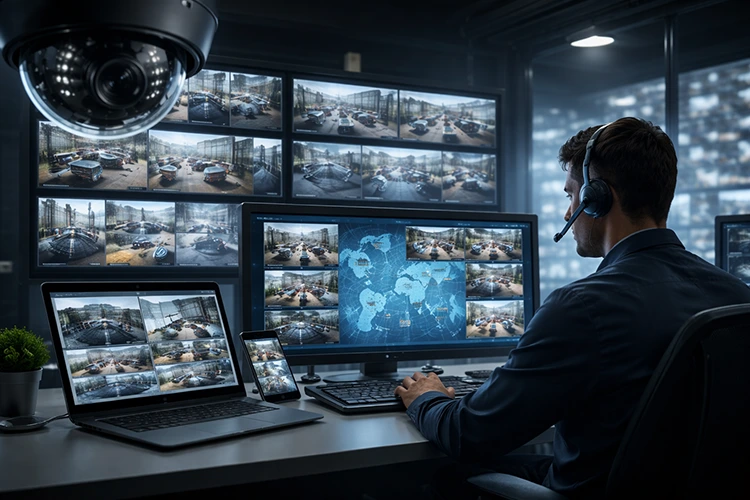
If you have CCTV cameras installed on your premises but nobody watching them in real time, you don’t have a monitoring solution — you have a recording system. The two are fundamentally different, and the distinction matters significantly when it comes to preventing incidents rather than simply documenting them after the fact.
Remote CCTV monitoring means that professionally trained operators — based at a secure, staffed Alarm Receiving Centre (ARC) — are actively watching live footage from your site around the clock. When something suspicious is detected, they act immediately: issuing audio warnings, contacting your keyholder, dispatching a response officer, or calling the police.
This article explains exactly how that process works, what happens behind the scenes at a monitoring control room, and why it delivers substantially better protection than passive recording or self-monitored systems.
Remote CCTV monitoring is a managed security service in which your CCTV cameras are connected — via a secure network link — to a staffed Alarm Receiving Centre that operates 24 hours a day, 365 days a year.
Rather than simply recording footage to a local hard drive, your cameras transmit live video feeds to a team of licensed operators who watch for unusual activity, respond to alarm triggers, and take action on your behalf whenever a genuine threat is identified.
The key distinction is this: recording captures what happened. Monitoring prevents it from happening, or stops it from escalating.
For remote monitoring to function, your CCTV system needs to be able to send a live video signal to the monitoring centre. This is typically achieved through one of two methods:
Most modern CCTV systems use IP (internet protocol) cameras, which transmit footage as data packets over a broadband or dedicated fibre connection. These feeds are encrypted for security and routed through to the ARC, where they appear on the operators’ monitoring screens in real time.
For sites without reliable fixed-line broadband — such as construction sites, remote industrial facilities, or temporary security deployments — cameras can transmit via a 4G or 5G mobile data connection. This is particularly common with mobile CCTV tower systems.
In both cases, the connection is secured with end-to-end encryption, and your monitoring provider should maintain redundant connectivity to ensure the feed is never lost due to a single point of failure.
Can existing cameras be used?
In most cases, yes. A professional monitoring provider will assess your existing camera hardware and network infrastructure to determine compatibility with their ARC. If upgrades are needed — for example, to ensure adequate image resolution or reliable connectivity — they will advise you on the most cost-effective options.
Today’s remote CCTV monitoring is not simply a matter of operators staring at screens all night. Advanced AI analytics software runs continuously in the background, analysing every video feed and flagging activity that falls outside defined parameters.
AI-enhanced monitoring systems can be configured to detect:
When the AI identifies activity that meets a threshold for concern, it generates an alert. A trained operator then reviews the live footage to determine whether the alert represents a genuine security event or a false alarm.
This combination of automated detection and human judgement is what distinguishes professional CCTV monitoring from basic alarm systems: the AI never misses a moment, and the operator never reacts without proper verification.
Understanding what happens when an alert is triggered is important for any business owner considering a monitoring service. Here is the full process, from detection through to resolution:
An alert is generated, either by the AI analytics system detecting suspicious activity, by a traditional alarm sensor (motion detector, door contact, etc.) being triggered, or by a camera detecting unusual movement during a timed quiet period.
A trained, SIA-licensed CCTV operator immediately reviews the live footage from the relevant cameras. They assess the nature of the activity, check adjacent camera feeds to get a wider view of the situation, and make a judgement on whether this is a genuine threat or a false alarm.
If the alert is determined to be a false alarm — caused by wildlife, a staff member working late, or a passing vehicle — the operator logs it and returns to monitoring. No unnecessary response is triggered, saving you the cost and inconvenience of a callout.
If a genuine security event is confirmed, the operator initiates a pre-agreed response protocol, which may include one or more of the following actions:
Every event — whether a false alarm or a confirmed security incident — is logged with a timestamp, a description of the activity, and a record of the actions taken. You receive a full incident report, which can also be used as supporting evidence if a police investigation or insurance claim follows.
Remote CCTV monitoring can be configured in two primary ways, depending on your site’s requirements:
| Monitoring Type | When It’s Used |
| Continuous (24/7/365) | Cameras are monitored at all times, with no gaps in coverage. Suitable for high-risk sites, those handling valuable goods, or premises that are routinely targeted. |
| Timed monitoring | Monitoring is active only during specified hours — typically overnight and at weekends when the site is unoccupied. Cost-effective for lower-risk premises that have staff on-site during the day. |
| Event-triggered monitoring | The connection to the ARC is activated when a sensor or alarm is triggered, rather than streaming continuously. This reduces data costs while still ensuring rapid response when needed. |
To connect your site to a monitoring centre, you typically need the following:
A reputable provider will carry out a full technical assessment of your existing infrastructure before designing a monitoring solution tailored to your site.
Many business owners start with a self-monitored CCTV system — cameras linked to an app on their phone, with push notifications when motion is detected. This works up to a point, but has significant practical limitations:
Professional remote monitoring removes all of these problems. Trained operators handle every alert, every time, regardless of the hour — and have the tools and authority to deploy a coordinated response immediately.
Why verified response matters for police attendance
Police forces across the UK prioritise calls from monitored alarm systems where a human operator has visually confirmed criminal activity in progress. Unverified alarm calls — where there is no visual confirmation — are significantly less likely to result in rapid police attendance. This is one of the most important practical advantages of professional CCTV monitoring over self-monitored systems.
Remote CCTV monitoring is used across a wide range of industries and property types, including:
Not all monitoring services are equal. When evaluating providers, the following criteria are particularly important:
Call: 0800 799 9800 (available 24/7) Email: info@veritech-security.com Or request a free consultation online.

Head Office
18-20 Millbrook Road East,
Southampton, Hampshire, SO15 1HY
Tel: 0800 799 9800
Email: info@veritech-security.com
Hours: Monday - Sunday: Open 24 Hours

© 2026 Veritech Security is a trading name of Veritech Systems Limited | Company Registration No. 07095234 | Social Responsibility Policy | Sitemap | Privacy Policy | Policies and Procedures | Veritech Systems Limited holds SIA approved contractor status for Security Guarding, CCTV and Keyholding security services.
Simply complete our quick survey below
