

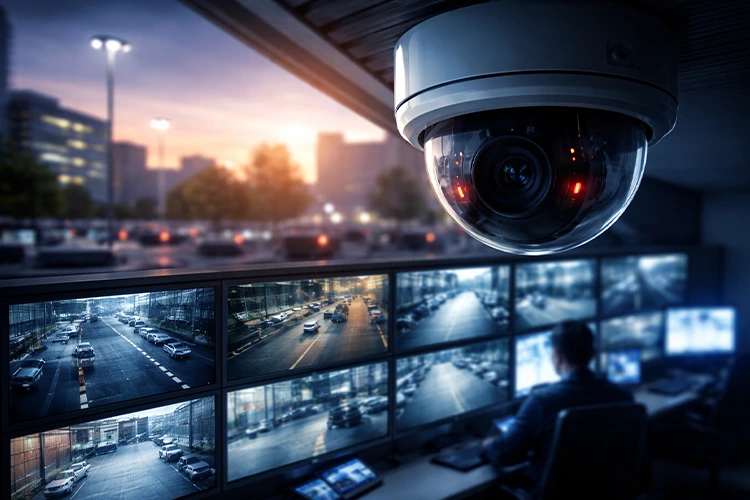
One of the most common questions businesses ask when evaluating their security arrangements is whether around-the-clock CCTV monitoring is genuinely necessary — or whether a more limited approach would provide adequate protection at a lower cost.
The honest answer is: it depends on your site, your risk profile, and what you stand to lose. But the data makes a compelling case for continuous monitoring in a wider range of situations than many businesses initially assume.
This article walks through the key factors that should inform your decision, the real cost of relying on partial coverage, and how to assess whether your current security arrangements are genuinely sufficient.
A key statistic Research consistently shows that the majority of commercial break-ins occur outside of normal working hours — either overnight, at weekends, or during bank holidays. A security arrangement that only provides coverage during business hours leaves your premises unprotected at precisely the times when it is most at risk.
Most business premises are occupied and actively managed for around 8–10 hours per day, five days a week. That leaves approximately 128 hours per week — around 75% of all available time — during which the site is unstaffed.
Criminals are well aware of this pattern. Commercial burglars, in particular, tend to operate during predictable windows:
Construction sites face additional exposure during every phase of a project, since valuable materials and plant equipment are often left on site overnight with limited physical security.
The question, then, is not whether your premises are at risk during these periods — they almost certainly are. The question is whether your current security measures are capable of detecting and responding to an incident during those times.
Many businesses operate CCTV systems that record footage continuously but have no live monitoring component. In these arrangements, cameras capture everything that happens on site — but nobody reviews it unless an incident is subsequently reported.
This is sometimes referred to as “forensic” CCTV: it is useful for investigating what happened after the fact, but does nothing to prevent an incident from occurring or to stop it from escalating once it has begun.
Consider the practical implications:
A monitored system, by contrast, enables immediate intervention. The value is not in having a record of what happened — it is in stopping it from happening, or minimising the damage whilst it is underway.
For businesses that recognise the need for 24-hour protection, the traditional alternative to CCTV monitoring has been on-site manned guarding — a security officer physically present at the premises overnight. However, the cost difference between the two approaches is substantial.
| Security Approach | Approximate Cost Implication |
| Manned guarding (single officer, overnight) | Typically £150–£300+ per shift, depending on hours and location. For a 7-night week, this equates to £1,050–£2,100 or more per week. |
| Professional CCTV monitoring | Monthly subscription fees vary by site complexity and camera count, but are typically a fraction of equivalent manned guarding costs. |
| Self-monitored CCTV | Low direct cost, but places the burden of response on you personally — and provides no professional response capability. |
For many sites — particularly those that are regularly targeted but do not require a constant physical presence — professional CCTV monitoring represents the most cost-effective way to achieve genuine 24-hour protection.
It is also worth noting that CCTV monitoring is not an either/or choice with manned guarding. Many businesses use both in combination: remote monitoring for overnight and weekend coverage, with physical guards deployed during high-risk events, periods of elevated activity, or in response to a confirmed incident.
Work through the following questions honestly. The more “yes” answers you give, the stronger the case for continuous professional monitoring.
Previous incidents are the single strongest predictor of future ones. If your site has suffered a break-in, attempted theft, or vandalism in the past three years, the risk of recurrence is significantly higher than for sites with no incident history.
High-value items — whether that is construction plant, electronic equipment, stock, raw materials, or vehicles — make a site a more attractive target. If the value at risk on your premises exceeds the annual cost of professional monitoring by a meaningful margin, the business case for monitoring is clear.
Vacant properties, sites between construction phases, and premises that close at weekends are particularly vulnerable. Extended unoccupied periods give potential intruders time to assess access points and plan a visit without risk of encounter.
Many commercial insurance policies include conditions relating to site security, particularly for high-value premises or those in elevated-risk locations. Failure to meet these conditions can invalidate a claim. NSI-accredited monitoring is often specifically recognised by insurers as meeting required standards.
If an alarm triggers at 2am and you have no keyholder within a reasonable distance, or no protocol for dispatching a response, your alarm system is effectively providing a notification without a consequence. Professional monitoring provides the response capability your alarm system alone cannot.
Businesses with high rates of false alarm callouts often find that staff and keyholders stop responding promptly — a phenomenon known as alarm fatigue. Professional monitoring includes visual verification before any response is triggered, dramatically reducing the rate of unnecessary callouts.
Large sites, multi-building complexes, and premises with significant perimeter length are difficult to patrol effectively with a single security officer. Remote monitoring allows multiple camera feeds to be watched simultaneously, providing comprehensive coverage that a single guard on foot cannot match.
Full 24-hour monitoring is not the only option. If your risk is concentrated at specific times — for example, overnight and at weekends, but not during staffed business hours — timed monitoring can provide targeted coverage during the highest-risk periods at a lower cost than continuous service.
Your monitoring provider should be able to configure your system to activate automatically at set times, or in response to alarm triggers, so that you are paying only for the coverage you genuinely need.
For businesses with particularly high overnight risk — such as construction sites during active phases — 24-hour coverage is generally advisable. For lower-risk office premises, timed overnight monitoring may represent a proportionate and cost-effective solution.
The hidden cost of inadequate security When calculating whether monitoring is cost-effective, it is important to account for the full cost of an incident — not just the direct value of what is stolen. This includes: repair costs for forced entry, lost productivity while premises are secured, increased insurance premiums following a claim, cost of replacing irreplaceable items or documents, staff time spent dealing with the aftermath, and reputational impact if clients or partners are affected.
For sites with staff working alone during unsociable hours — night-shift workers, lone security officers, staff conducting early-morning deliveries — 24-hour monitoring provides an important additional layer of protection beyond simple property security.
A monitoring centre can be configured to conduct automated welfare checks at set intervals. If a lone worker fails to check in, the operator immediately initiates a call and, if necessary, dispatches a response officer or contacts the emergency services. This capability can be critical in situations where a worker has suffered an accident, a medical emergency, or an assault.
The Health and Safety at Work etc. Act 1974 and the Management of Health and Safety at Work Regulations 1999 together place a duty on employers to assess and mitigate risks to lone workers. The 1999 Regulations specifically require employers to make a suitable and sufficient assessment of risks to employees — including those working alone — and to put adequate controls in place. For many businesses, professional monitoring is a key component of meeting these obligations.
If you are still unsure whether 24-hour monitoring is right for your premises, the most practical starting point is a professional security assessment. A reputable provider will evaluate your site, identify your risk profile, and recommend a monitoring solution that is proportionate to your actual exposure — without upselling services you do not need.
At Veritech, we provide site consultations and security assessments for businesses across the UK. Our team will give you an honest assessment of your current arrangements and the options available to you.
Call: 0800 799 9800 (available 24/7) Email: info@veritech-security.com Or request a free consultation online.

Head Office
18-20 Millbrook Road East,
Southampton, Hampshire, SO15 1HY
Tel: 0800 799 9800
Email: info@veritech-security.com
Hours: Monday - Sunday: Open 24 Hours

© 2026 Veritech Security is a trading name of Veritech Systems Limited | Company Registration No. 07095234 | Social Responsibility Policy | Sitemap | Privacy Policy | Policies and Procedures | Veritech Systems Limited holds SIA approved contractor status for Security Guarding, CCTV and Keyholding security services.
Simply complete our quick survey below
