

Investing in perimeter security is a straightforward decision in principle — keep threats out before they reach your assets, your people, or your operations. In practice, the benefits extend well beyond the obvious. A well-designed perimeter security system has measurable operational, financial, and regulatory value that compounds over the life of the installation.
This article sets out the concrete benefits that commercial and industrial operators should expect from a properly specified perimeter security system.
The single most important advantage of perimeter security over any other security layer is timing. When a sensor or detection system triggers at the site boundary, an intruder is still outside. Your assets, your staff, and your infrastructure are still safe. Every other security layer — internal alarms, access control, building CCTV — responds to a threat that has already breached the boundary and is already inside.
That time difference is the difference between a prevented incident and a police report written after the fact.
Modern Perimeter Intrusion Detection Systems (PIDS) detect crossing of a boundary line using infrared, microwave, or radar sensors — technologies that operate in complete darkness, adverse weather, and harsh outdoor conditions. When a sensor fires, an alert reaches a monitoring centre immediately. A trained operator verifies the activation, assesses the nature of the intrusion, and dispatches a response before the intruder has reached any asset on site.
The best security outcome is an intrusion attempt that never happens. Visible perimeter security changes the risk calculus for a would-be intruder significantly — and documented research across multiple sectors consistently shows that sites with visible, monitored security are targeted far less frequently than those that appear unprotected.
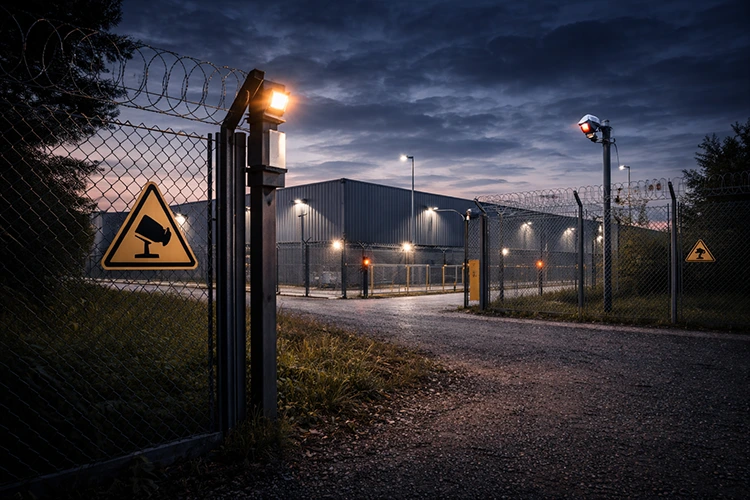
This deterrence effect operates at several levels. Physical indicators — cameras, sensor units, warning signage — communicate that the site is monitored and that response will be rapid. The knowledge that a monitored system is in place, and that operators will be alerted within seconds of a boundary breach, removes the window of low-risk opportunity that most opportunistic criminals rely on.
For construction sites and remote assets in particular — where long response times and isolation have historically made sites attractive targets — the deterrence value of visible perimeter security is substantial.
The financial case for perimeter security is direct. The direct costs of a successful intrusion — stolen plant, damaged infrastructure, stolen cabling — are significant. The indirect costs are frequently larger.
A construction site that loses a telehandler or an excavator overnight faces immediate programme disruption while replacement is arranged. Insurance claims take time. Smaller contractors may carry equipment losses directly. A solar farm that suffers copper cable theft faces repair work that can take weeks and reduced generation revenue throughout.
Studies and insurance data consistently show that the annual cost of a properly specified perimeter security system is materially lower than the expected cost of incidents without it, particularly on sites with high-value assets or known theft exposure. For many site types, a single prevented incident recovers the full cost of installation.
UK commercial and industrial insurers increasingly treat demonstrable perimeter security as a condition of cover rather than a factor that merely reduces premiums. For sectors with established theft profiles — construction, energy, logistics, storage — insurers may require specific security measures, including monitored perimeter detection, as a prerequisite for policy issuance or claims acceptance.
A perimeter security system installed by an accredited provider and connected to a recognised monitoring centre provides the documented evidence that insurers require. This matters both at renewal — where documented security provision supports favourable premium assessment — and in the event of a claim, where an absence of specified security measures can result in repudiation.
For site operators working within supply chains that carry their own security requirements — principal contractors under NEC or JCT contracts, for example — documented perimeter security also supports contractual compliance and tender qualification.
Most security incidents on commercial and industrial sites happen outside normal operating hours — overnight, at weekends, and during holiday shutdowns. These are precisely the periods when on-site presence is lowest, response times are longest, and the window of low-risk opportunity for intruders is widest.
A perimeter security system connected to 24/7 monitoring provides protection across the full operating cycle without the cost of maintaining a permanent on-site security presence at all times. Alerts are received and acted upon at 2am on a Saturday just as they are at 2pm on a Tuesday.
This is particularly relevant for sites that experience seasonal variation in risk — construction projects during summer shutdowns, solar farms over holiday periods, vacant sites between tenancies — where risk peaks at exactly the moment on-site presence drops.
A well-specified perimeter security system is not a fixed installation. Modern wireless systems can be rapidly redeployed as site layouts change — critical on construction projects where the highest-risk zones shift as work progresses, or for businesses that need to extend coverage as their footprint grows.
Wireless sensor units can be moved, additional units added to extend coverage, and monitoring protocols updated without the disruption and cost of cable-based infrastructure changes. This scalability means that perimeter security can grow with the site rather than becoming obsolete as requirements evolve.
When incidents do occur, perimeter security systems produce documentation that supports investigation and, where appropriate, prosecution. CCTV footage integrated with PIDS alert timestamps creates a coherent evidential record — not just footage of someone already on site, but a sequence that shows boundary breach, approach, and activity.
Monitoring centre records also provide a documented timeline of alerts and responses that supports both internal incident review and any subsequent legal proceedings. For businesses with contractual obligations around site security, this documentation can be significant in demonstrating that appropriate measures were in place.
Veritech Security designs and installs perimeter security systems that deliver all of these outcomes — with the monitoring infrastructure, maintenance programmes, and accreditations that make them operationally effective and commercially credible.
Our services include PIDS deployment using infrared, microwave, and radar sensor technologies; wireless solar and battery-powered detection for remote and off-grid sites; integrated CCTV and thermal imaging configured for immediate visual verification; NSI Gold-accredited 24/7 monitoring with rapid verified response; mobile CCTV towers for temporary or evolving site coverage; and structured maintenance programmes that protect system performance and keep documentation current.
We hold SIA approved contractor status alongside ISO 9001, ISO 14001, Constructionline, SafeContractor, RISQS, Achilles, and Cyber Essentials accreditations — standards that carry weight with insurers, supply chain procurement teams, and regulatory bodies across the sectors we serve.
If you want to understand the specific benefits a perimeter security system would deliver for your site, speak to Veritech.
Call: 0800 799 9800 (available 24/7) Email: info@veritech-security.com Or request a site security consultation online.

Head Office
18-20 Millbrook Road East,
Southampton, Hampshire, SO15 1HY
Tel: 0800 799 9800
Email: info@veritech-security.com
Hours: Monday - Sunday: Open 24 Hours

Simply complete our quick survey below
