

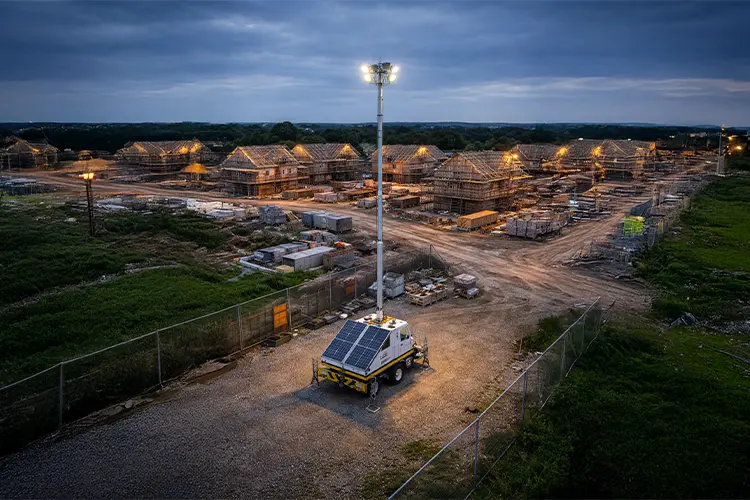
Mobile CCTV towers have become one of the most widely used security measures on UK construction sites — and for good reason. For sites without permanent infrastructure, fixed CCTV is rarely practical, and manned guarding alone is expensive for 24/7 coverage. Mobile CCTV towers solve both problems: they are self-contained, rapidly deployable, and connected to professional monitoring around the clock. This guide explains how they work, what to expect from a well-specified system, and how to decide whether they are the right solution for your site.
A mobile CCTV tower is a self-contained surveillance unit mounted on a freestanding mast — typically between five and six metres in height — that can be transported to any location, set up in a matter of hours, and connected to a remote monitoring centre without requiring fixed internet infrastructure or mains power. They are designed specifically for environments where permanent installation is not possible or not cost-effective.
On a construction site, that means you can place a tower overlooking a compound of high-value plant, position one at a vulnerable site entrance, or cover a large open area where a fixed camera would require significant groundworks to install. When your site layout changes, the tower moves with it.
The core components of a mobile CCTV tower are the camera system, the power supply, the communication link, and the monitoring connection. Each plays a distinct role in making the system effective.
Cameras are mounted at height to maximise coverage. A well-specified tower will carry HD cameras — either fixed bullet cameras covering defined zones or a pan-tilt-zoom (PTZ) camera that can be remotely directed to track movement or investigate an alert. Night vision capability is standard on any system worth deploying.
The communication link is typically 4G or 5G, using a SIM card that does not depend on your site’s broadband or Wi-Fi. This matters enormously on construction sites, where temporary internet connections are unreliable and often absent entirely.
When motion is detected, the camera system sends an alert to the monitoring centre. Trained operators view the live feed, assess whether the activity is a genuine intrusion, and respond accordingly — this might mean issuing a live audio warning via a two-way speaker on the tower, contacting the site manager, or escalating to police.
The majority of mobile CCTV towers deployed on UK construction sites run on solar power with battery backup. A solar panel charges a bank of batteries during daylight hours; those batteries power the system continuously through the night. On a well-engineered system, this cycle sustains the tower through extended periods of overcast weather without interruption.
Mains-connected options exist and may be appropriate where a reliable power supply is on site and the priority is maximum camera performance rather than deployment flexibility. Hybrid systems — solar-primary with a mains fallback — are common where some power infrastructure exists but the deployment location is uncertain.
For sites where mains power is genuinely unavailable — remote infrastructure projects, agricultural land, highway works — solar is typically the only practical choice. Our guide to solar-powered CCTV towers covers the technical detail and what to check before hiring.
Not all CCTV towers carry equivalent camera specifications. The following are the minimum you should expect from a professionally deployed system:
A PTZ camera adds the ability for monitoring operators to track movement across the site in real time, which is particularly valuable on large or complex sites where a single fixed camera cannot cover all risk areas.
This is the question that separates effective CCTV tower deployments from expensive deterrents. A tower that records footage but has no live monitoring is passive — it captures evidence after the fact, but it does not stop an incident from happening.
A properly monitored tower is connected to an alarm receiving centre (ARC) staffed around the clock by trained operators. When motion is detected, operators receive an alert and view the live feed within seconds. They assess the situation and respond — issuing an audio challenge, contacting emergency services, or triggering a pre-agreed response protocol.
The accreditation of the monitoring centre matters here. NSI Gold Cat II is the recognised standard in the UK for ARCs providing intruder alarm and CCTV monitoring. Many construction insurers and principal contractors now require evidence that monitoring is provided by an NSI Gold-accredited centre. If your supplier cannot confirm this, the monitoring may not meet your insurance or compliance requirements.
Mobile CCTV towers are used across a wide range of sites, but their design makes them particularly well-suited to construction:
Towers are also used outside construction for vacant properties, events, agricultural land, and retail car parks — but the construction application is where their particular combination of mobility, off-grid power, and rapid deployment is most valuable.
A professional supplier should be able to assess your site within 24 to 48 hours of enquiry, confirm the specification, and have a tower operational within the same week. Emergency deployments — following a break-in or in response to an immediate threat — can often be arranged more quickly.
Installation itself typically takes two to four hours, depending on ground conditions and site access. The tower arrives on a specialist trailer; the team positions it, extends the mast, configures the camera zones, tests the communication links, and connects it to the monitoring centre before leaving site. There is no groundwork, no cable-laying, and no requirement to liaise with other trades.
Mobile CCTV towers are designed for both short-term and long-term deployment. Hire periods can run from a matter of weeks to several years. For construction sites, the hire term typically tracks the project programme — from the point at which high-value plant arrives on site to the point at which permanent security systems are operational.
Because the towers are redeployable, they can move with the site as it develops. A tower covering the compound in the early groundworks phase can be repositioned to cover a vulnerable perimeter as the building rises, then moved again to protect a completed floor awaiting fit-out.
Before hiring from any supplier, it is worth asking specific questions about the specification and monitoring. Our dedicated guide — what to look for when hiring a mobile CCTV tower — covers this in detail, including the accreditations and technical specs that differentiate a capable system from a basic one.
It is also worth understanding the differences between a mobile CCTV tower and alternative camera options. Our guide to mast cameras vs CCTV towers explains the distinction and helps you decide which is more appropriate for your site.
Veritech Security works with principal contractors, project managers, and construction businesses across the UK to deploy, monitor, and manage mobile CCTV tower solutions that protect sites from groundworks through to handover.
Our services relevant to mobile CCTV towers and construction site security include mobile CCTV tower deployment — rapidly deployable solar and hybrid towers with 24/7 NSI Gold-accredited monitoring; SIA-licensed manned guarding and dog handler patrols for higher-risk phases and access control; construction site CCTV installation — permanent systems for longer-term protection on larger schemes; scaffold alarms and access control systems for compound and plant protection; and free site surveys to assess vulnerabilities and design a layered security plan.
We hold SIA Approved Contractor status alongside ISO 9001, ISO 14001, Constructionline Platinum, SafeContractor, RISQS, Achilles, and Cyber Essentials accreditations — the credentials that principal contractors and their insurers expect to see.
If you have a construction project that needs mobile CCTV coverage, speak to Veritech before the plant goes on site.
Call: 0800 799 9800 (available 24/7) Email: info@veritech-security.com Or request a free site survey online.

Head Office
18-20 Millbrook Road East,
Southampton, Hampshire, SO15 1HY
Tel: 0800 799 9800
Email: info@veritech-security.com
Hours: Monday - Sunday: Open 24 Hours

Simply complete our quick survey below
