

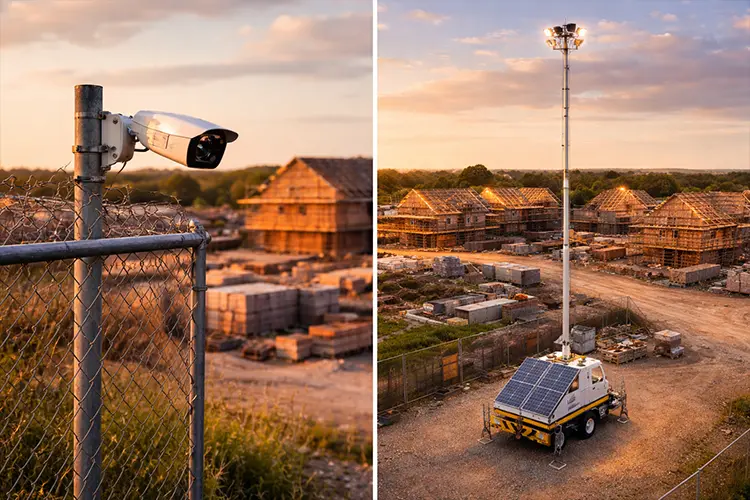
If you are evaluating temporary CCTV options for a construction site or an exposed piece of land, you will quickly encounter two terms used interchangeably: mast-mounted cameras and CCTV towers. They are not the same thing. Understanding the distinction will help you make the right decision — and avoid paying for a specification that does not match your actual security requirement. Veritech’s mobile CCTV tower service is available across the UK with free site surveys to help you choose the right solution.
A mast camera — sometimes called a pole-mounted camera — is exactly what it sounds like: a CCTV camera fixed to the top of a pole or mast, typically between three and five metres in height. The mast is usually anchored to the ground or bolted to an existing structure, and the camera is hardwired or wirelessly connected to a recording unit.
Mast cameras are widely used for permanent or semi-permanent installations — at site entrances, in car parks, on the perimeters of compounds, or to cover specific fixed areas such as plant storage. They are lower-cost per unit than a mobile CCTV tower, and for static locations with existing power and cabling infrastructure, they can be the right choice.
What they are not is flexible. A mast camera covers one fixed zone. Moving it requires dismantling the mounting, which may involve groundworks, and reinstalling it elsewhere. On a dynamic construction site, where the risk profile changes as the project advances, that inflexibility is a significant limitation.
A mobile CCTV tower is a self-contained security unit comprising a telescopic mast — typically five to six metres — mounted on a weighted trailer base, carrying multiple cameras, a power supply (usually solar with battery backup), a 4G/5G communication link, and an audio deterrent speaker. The entire unit can be transported, positioned, and made operational within hours, without requiring any fixed infrastructure.
The key distinction is not just the height — though height matters enormously for coverage — but the integration of power, communication, monitoring connectivity, and audio response into a single deployable unit. A mast camera is a camera on a pole. A CCTV tower is a mobile security platform.
Height is the most immediately obvious difference, and it has a direct bearing on how much of your site a single unit can cover. A three-metre mast camera covers a relatively narrow field of view at ground level. A six-metre tower — particularly with a pan-tilt-zoom camera — can surveil a much larger area and maintain useful image quality at significantly greater distances.
On a construction site, this translates directly to the number of units you need to achieve adequate coverage. A single well-positioned CCTV tower can monitor an entire compound, including multiple entry points and material storage areas, where several mast cameras would be required to achieve equivalent visibility.
A mast camera requires both power and a network connection to function. On a construction site — particularly in the early phases — neither may be reliably available. Running cables across a live site creates practical and safety challenges; temporary power supplies add cost and failure risk.
A mobile CCTV tower is specifically designed to operate where none of this infrastructure exists. Solar panels charge batteries continuously; 4G or 5G connectivity eliminates the need for any site cabling. The system functions in the middle of a field, on a remote rural site, or in the early groundworks phase of a development before any services are connected.
This is where the comparison becomes most important from a security effectiveness standpoint. Many mast camera installations record footage locally or to a cloud server. Unless that footage is actively monitored in real time, the system is reactive — it tells you what happened, but it does not stop an incident occurring.
A mobile CCTV tower, when properly specified, connects to an NSI Gold-accredited alarm receiving centre (ARC) whose operators are watching in real time. When motion is detected, an operator reviews the live feed, challenges the intruder via the tower’s audio speaker, and escalates to police if required. The system actively deters and responds, rather than simply recording.
This combination of real-time monitoring and on-site audio challenge is what most construction insurers mean when they require “monitored CCTV” as a policy condition. A mast camera recording to a DVR typically does not satisfy that requirement.
Per unit, mast cameras cost less than CCTV towers. On a purely hardware comparison, this is true. But for temporary construction site security, the relevant cost comparison is different: how many mast cameras would you need to achieve the same coverage as one tower, and what is the cost of installing, cabling, and powering them?
On most active construction sites, a properly positioned CCTV tower provides comparable or superior coverage to three or four mast cameras, without the infrastructure requirement. When you factor in monitoring subscription costs, the total cost of ownership over a typical project period is often similar — with the tower providing significantly better deterrence and response capability.
Yes, and on larger schemes this is often the right approach. Mobile CCTV towers work well for covering large open areas, compounds, and high-risk zones where real-time monitoring and audio deterrence are the priority. Mast-mounted cameras — either temporary or moving towards permanent installation — suit fixed, well-defined points such as main site entrances, pedestrian gates, or plant storage areas where the position will not change.
A layered security plan might use two or three CCTV towers for wide-area surveillance and deterrence, supplemented by mast cameras at fixed access points feeding into the same monitoring platform. Veritech designs integrated solutions of this kind as part of a free site survey.
The clearest indicators that a mobile CCTV tower is the right choice:
A mast camera is more appropriate when:
For a full assessment of what to look for when comparing suppliers and specifications, see our guide: what to look for when hiring a mobile CCTV tower for a construction site. For a broader introduction to how mobile CCTV towers work, see our complete guide to mobile CCTV towers.
Veritech Security works with principal contractors, project managers, and construction businesses across the UK to deploy, monitor, and manage mobile CCTV tower solutions that protect sites from groundworks through to handover.
Our services relevant to mobile CCTV towers and construction site security include mobile CCTV towers — self-contained, solar-powered units with live NSI Gold-accredited monitoring and audio deterrence; construction site CCTV installation — fixed and semi-permanent systems for defined access points and compounds; free site surveys to design the right combination of mobile and fixed surveillance for your specific project; and SIA-licensed manned guarding where physical presence is required alongside or instead of CCTV coverage.
We hold SIA Approved Contractor status alongside ISO 9001, ISO 14001, Constructionline Platinum, SafeContractor, RISQS, Achilles, and Cyber Essentials accreditations — the credentials that principal contractors and their insurers expect to see.
If you have a construction project that needs mobile CCTV coverage, speak to Veritech before the plant goes on site.
Call: 0800 799 9800 (available 24/7) Email: info@veritech-security.com Or request a free site survey online.

Head Office
18-20 Millbrook Road East,
Southampton, Hampshire, SO15 1HY
Tel: 0800 799 9800
Email: info@veritech-security.com
Hours: Monday - Sunday: Open 24 Hours

Simply complete our quick survey below
