

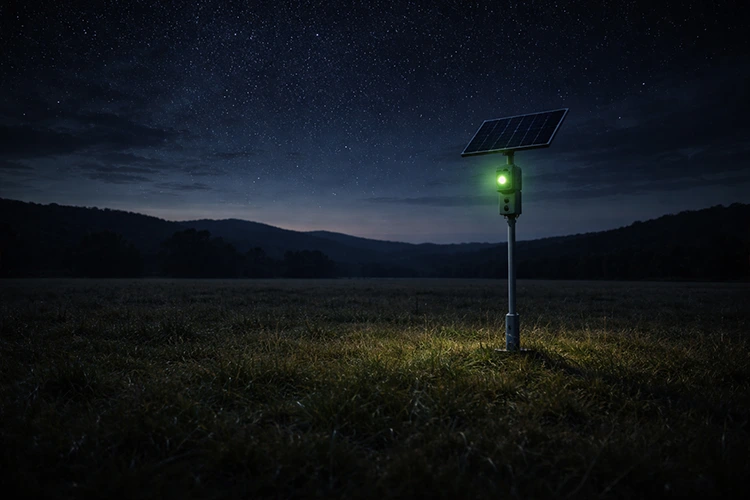
One of the most common questions we hear from clients with remote or rural sites is straightforward: how do you protect a large outdoor area when there’s no mains electricity available?
It’s a genuine challenge. Traditional hardwired security systems — fixed CCTV, wired perimeter alarms, access control infrastructure — all depend on a reliable power supply. On a construction site in a greenfield location, a solar farm on agricultural land, a utilities compound, a rural storage facility, or a remote transport hub, mains power is often simply not available.
The good news is that modern perimeter security systems have been purpose-built to address exactly this problem. Protecting a remote or off-grid site effectively no longer requires a mains connection — and in many cases, wireless off-grid technology outperforms a wired installation on large open terrain.
Sites without mains infrastructure tend to share several characteristics that increase their security risk:
Distance from police resources. Rural and remote locations typically experience longer emergency response times. An intruder who would be deterred by the prospect of a five-minute police response in an urban area has far more time to act on a remote site.
Limited natural surveillance. There are no passing pedestrians, no neighbouring businesses, no residential properties with occupied windows. Criminal activity can go unobserved for extended periods.
Valuable assets. Remote sites often hold high-value assets — plant, equipment, fuel, cable, specialist materials — that are difficult to monitor and easy to sell quickly.
No on-site presence. Many remote commercial sites operate without any permanent staff, particularly overnight and at weekends.
The combination of high value, low visibility, and slow response creates exactly the conditions that organised criminal groups target.
The most significant development in remote site security over the past decade has been the maturation of solar and battery-powered wireless detection systems. Modern perimeter intrusion detection systems can run entirely independently of mains power, using solar panels combined with battery storage to maintain continuous operation year-round — including through the shorter daylight hours of winter months.
Wireless sensor units are deployed along the site boundary, communicating via GPRS or radio rather than physical cable runs. When a breach is detected, an alert is transmitted instantly to a 24/7 monitoring centre, regardless of where on the perimeter the intrusion occurred.
For large sites, multiple units can be deployed to provide coverage across expansive boundaries — with coverage extendable to 2,000 metres or more using linked sensor arrays.
Mobile CCTV towers are self-contained security platforms that require no fixed power supply. Units combine solar panels, wind turbines, or high-capacity batteries with HD cameras, motion detection, powerful LED lighting, and cellular communication to a monitoring centre.
A key advantage of mobile towers is their flexibility. They can be positioned to cover the highest-risk areas of a site — equipment compounds, material storage areas, access gates — and repositioned as the site’s risk profile changes. On a construction site, for example, the area of highest risk shifts as the project progresses; a mobile tower can move with it.
Advanced towers include two-way audio, allowing monitoring centre operators to issue a verbal challenge to anyone approaching the site — often enough to deter opportunistic intruders without requiring a physical response.
Security systems on remote sites can’t rely on fixed-line broadband or landline connections. Modern remote security systems use GPRS or 4G cellular networks to communicate between on-site sensors and cameras and the monitoring centre. Where signal coverage is a concern — some genuinely remote sites have limited cellular coverage — specialist low-power wide-area networks (LPWAN) can be used to maintain connectivity.
This communication infrastructure is critical: a security system that cannot reliably report an intrusion to someone who can respond is not providing real protection.
Protecting a large outdoor site without mains power requires a system designed for that specific site rather than an off-the-shelf product. The key variables to assess include:
Site size and boundary length. Larger perimeters require more sensor coverage points. The system design needs to ensure there are no gaps that an intruder could exploit.
Terrain and vegetation. Dense vegetation can obstruct infrared sensor lines of sight. Uneven terrain affects camera coverage angles. A proper survey accounts for these factors.
Solar and weather conditions. Power generation from solar panels is affected by site orientation, shading, and seasonal variation. System design should include sufficient battery storage to maintain operation through extended low-light periods.
Specific threat profile. The most likely intrusion method — vehicle entry, fence cutting, perimeter climbing — influences sensor placement and type.
Communication coverage. Cellular signal strength across the site should be assessed before specifying communication-dependent equipment.
A typical deployment for a large remote site with no mains power might combine:
The entire system operates independently of any fixed power or data infrastructure. Installation is rapid — a site of this type can typically be operational within a day — and the system can be expanded, relocated, or removed as requirements change.
Veritech Security works with clients across the UK who manage sites where mains infrastructure isn’t available — from solar farms and utilities compounds to construction projects in greenfield locations and remote storage facilities.
Our services for remote and off-grid sites include wireless solar and battery-powered PIDS deployable across perimeters of any scale; mobile CCTV towers that operate independently of fixed power; GPRS and cellular-connected monitoring with no fixed-line dependency; NSI Gold-accredited 24/7 monitoring with verified response and mobile patrol dispatch; and rapid installation with minimal site disruption — typically operational within a single day.
We hold SIA approved contractor status alongside ISO 9001, ISO 14001, Constructionline, SafeContractor, RISQS, Achilles, and Cyber Essentials accreditations — giving asset owners and insurers confidence that security provision meets recognised standards.
If you manage a remote or off-grid site and want to understand what level of perimeter protection is achievable without a mains connection, speak to Veritech.
Call: 0800 799 9800 (available 24/7) Email: info@veritech-security.com Or request a free site security consultation online.

Head Office
18-20 Millbrook Road East,
Southampton, Hampshire, SO15 1HY
Tel: 0800 799 9800
Email: info@veritech-security.com
Hours: Monday - Sunday: Open 24 Hours

© 2026 Veritech Security is a trading name of Veritech Systems Limited | Company Registration No. 07095234 | Social Responsibility Policy | Sitemap | Privacy Policy | Policies and Procedures | Veritech Systems Limited holds SIA approved contractor status for Security Guarding, CCTV and Keyholding security services.
Simply complete our quick survey below
