

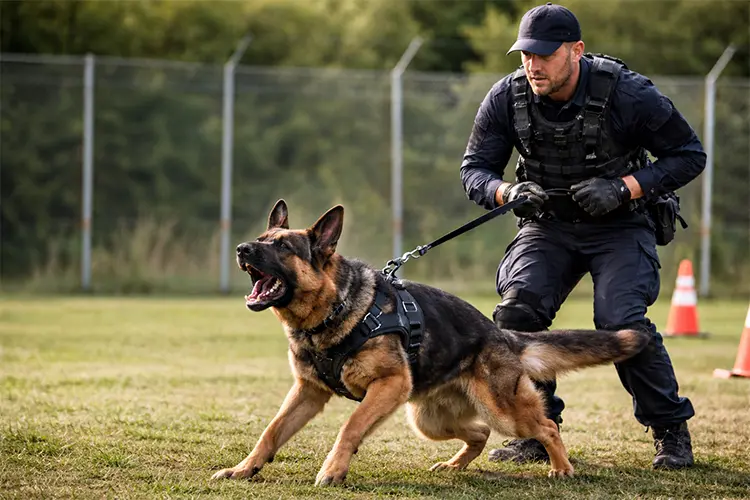
When you deploy a security dog team to protect your site, you are relying on years of careful, structured training — for both the dog and the handler. Yet few buyers ask the question that matters most: what does that training actually involve, and how do you know it meets UK professional standards?
This guide explains how security dogs are trained in the UK, which qualifications and standards govern that training, and what you should look for when selecting a compliant K9 security provider.
Security dog training in the UK focuses equally on the animal and the human. A dog that is perfectly trained but paired with an untrained handler is as much a liability as an asset. Equally, an experienced handler working with an inadequately trained dog creates unacceptable risk.
Responsible providers train both elements together, ensuring the working relationship between handler and dog is reliable, consistent, and professionally governed.
The National Association of Security Dog Users (NASDU) sets the benchmark for K9 security training in the UK. NASDU qualifications are recognised across the industry and by many public sector procurement bodies as evidence of professional competence.
The key handler qualification for general purpose dogs is the NASDU Level 2 Award for a General Purpose Security Dog Handler, endorsed by the Highfield Awarding Body for Compliance (HABC) — a regulated awarding organisation recognised by Ofqual, the SIA, and the SQA. This nationally recognised qualification covers:
Handlers must demonstrate practical competency before being assessed, meaning the qualification reflects real-world performance rather than purely theoretical knowledge.
BS 8517 is the British Standard that governs the deployment of security dogs in the UK. Part 1 covers general purpose security dogs — the patrol and deterrence dogs most commonly deployed on construction sites, industrial estates, and commercial properties. The standard covers everything from dog selection and temperament assessment through to kennelling requirements, deployment conditions, and emergency procedures.
Compliance with BS 8517 is not a legal requirement, but it is the accepted professional benchmark. Reputable providers will reference it explicitly in their operating procedures and risk assessments.
When reviewing a potential provider, ask to see their assignment instructions, welfare protocols, and risk assessments. These documents should directly reference BS 8517.
General purpose (GP) security dogs are trained primarily for patrol, deterrence, and threat detection. Training typically covers:
Before any security-specific training begins, the dog must demonstrate reliable obedience. This includes recall, recall under distraction, controlled walking on and off lead, and response to directional commands. A dog that does not respond reliably to its handler cannot be deployed safely.
Properly trained security dogs do not bite indiscriminately. Bite training is conducted in controlled environments, and dogs are trained to release on command. The emphasis is on controlled aggression — sufficient to detain a threat if necessary, but never deployed without handler direction.
GP dogs are trained to search buildings, vehicles, and open areas methodically. They learn to alert their handler when they detect a person or unusual activity, rather than acting independently.
Security dogs must remain calm and reliable in challenging environments — loud machinery, crowds, night conditions, and confined spaces. Socialisation training ensures the dog does not create a hazard in the very environments it is meant to protect.
Detection dogs — trained to find drugs, explosives, or other substances — undergo specialist training separate from general purpose work. Detection training uses a process called imprinting, where the dog learns to associate a specific odour with a reward. Over time, this response becomes reliable enough to be used operationally.
Detection dog handlers must hold dedicated NASDU qualifications specific to their specialist area — Level 3 Certificates for drug or tracking detection, and Level 4 Certificates for explosives detection. These are separate qualification streams from the general purpose handler pathway, not progressions from it.
Training does not end when a dog qualifies. Responsible providers conduct regular operational assessments to ensure standards are maintained. Dogs also receive routine veterinary checks, and their working lives are actively monitored to ensure they are not deployed beyond their capacity.
Animal welfare and professional performance are not in tension — a well-cared-for dog performs reliably. Providers who cut corners on welfare create operational risk as well as ethical problems.
Before engaging any K9 security provider, ask the following:
A provider who cannot answer these questions clearly should not be trusted with your site.
Understanding the training standards behind K9 security makes it easier to ask the right questions when selecting a provider. Not all companies operate to the same level, and the gap between a compliant team and a non-compliant one carries real operational and legal risk for your site.
Veritech’s K9 handlers hold NASDU Level 2 qualifications, and all deployments are supported by site-specific risk assessments and assignment instructions referencing BS 8517. Our dogs are welfare-registered with Southampton’s local authority and live with their dedicated handlers.
We are happy to walk you through our credentials, answer your questions about training and compliance, and provide a no-obligation quote for your site.
Call: 0800 799 9800 (available 24/7) Email: info@veritech-security.com Or request a consultation online.
Veritech Security’s K9 teams are NASDU-certified, fully compliant with BS 8517, and deployed with comprehensive risk assessments and welfare protocols. Speak to our team today to discuss your site’s requirements.
Related Articles

Head Office
18-20 Millbrook Road East,
Southampton, Hampshire, SO15 1HY
Tel: 0800 799 9800
Email: info@veritech-security.com
Hours: Monday - Sunday: Open 24 Hours

Simply complete our quick survey below
